1. IE browser is NOT supported anymore. Please use Chrome, Firefox or Edge instead.
2. If you are a new user, please register to get an IHEP SSO account through https://login.ihep.ac.cn/registlight.jsp Any questions, please email us at helpdesk@ihep.ac.cn or call 88236855.
3. If you need to create a conference in the "Conferences, Workshops and Events" zone, please email us at helpdesk@ihep.ac.cn.
4. The max file size allowed for upload is 100 Mb.

第五届JUNO相关的理论和唯象研讨会:首个物理成果专题研讨会

Asia/Shanghai
Description

 第五届JUNO相关的理论和唯象研讨会

------首个物理成果专题研讨会------

English version follows

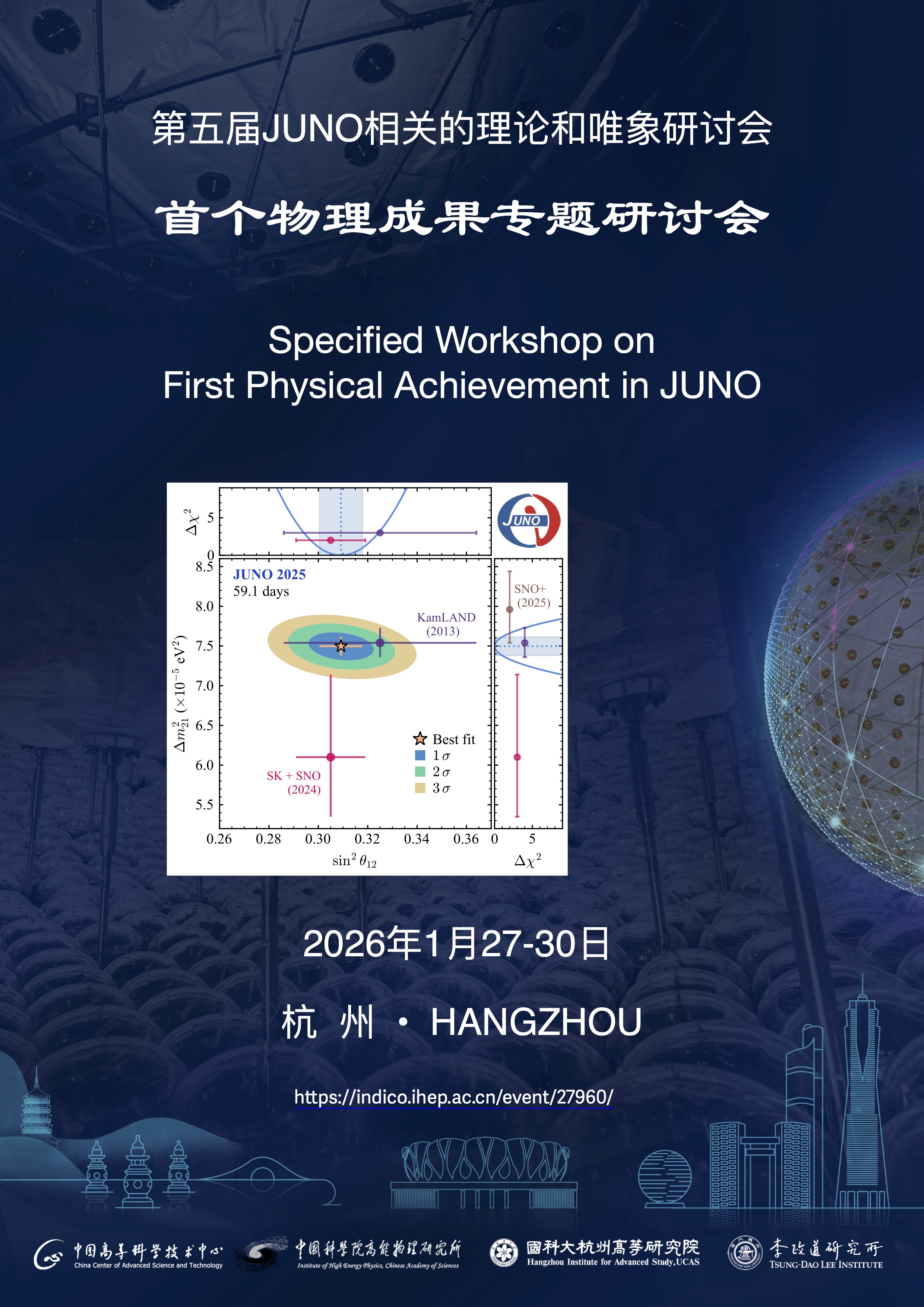
        2025年8月26日,江门中微子实验(JUNO)正式运行。2025年11月19日,JUNO发布了其首个物理成果。经过不到两个月时间的取数,JUNO就把对ν₁  ν₂两个中微子的质量平方差和对应的混合角的测量精度提高到了1.6%和2.8%。这一精度超出过去三十年国际上所有中微子实验探测的总和。

        JUNO首次运行即取得重要成果,这为实验的后续研究提供了坚实的信心保障。接下来,JUNO将围绕其首要目标——确定中微子的质量顺序(正序 m₁<m₂<m₃ 或者倒序 m₃<m₁<m₂ )——进行探测。除了首要目标外,在未来运行的若干年里,它还会在轻子味混合参数的精确测量、质子衰变、超新星中微子、太阳中微子、大气中微子、超出标准模型的新物理等诸多方面进行实验测量,有可能在多个方面获得重要成果,甚至是一些不可预期的发现。

        以JUNO为代表的全球中微子精确测量时代已经到来。JUNO,以及后面几年将会运行的日本顶级神冈实验(Ηyper-Kamiokande)和美国的深地中微子实验(DUNE),将会代表这个时代最重要的几个中微子实验,为实验上彻底解决中微子振荡问题给出最终答案。

        本次研讨会将以JUNO公布首个物理成果为契机,探讨江门实验可能带来的物理应用,实验结果对未来中微子理论走向的影响,以及实验探测背后的一些故事。欢迎感兴趣的同行专家参加!

https://indico.ihep.ac.cn/event/27960/

一、会议日期:2026年1月27日报到,28日、29日会议,30日离开

二、会议地点:国科大杭州高等研究院云艺园区,杭州

三、会议组织:周也铃(杭高院)、李玉峰(高能所)、周顺(高能所)、葛韶锋(李所)

四、食宿安排:食宿费用自理

五、会务联系:  王静    电话:17280167326  邮箱:SLXY@ucas.ac.cn
                              
江倩    电话:13261815088  邮箱:jiangqian@ihep.ac.cn


The 5th Workshop on JUNO-related Theory and Phenomenology

--- Specified Workshop on First Physical Achievement in JUNO ---


On August 26, 2025, the JUNO experiment officially started data collection. On November 19, 2025, JUNO released its first result. After collecting data for less than two months, JUNO has already improved the precision of the mass-squared difference between the ν₁ and ν₂ neutrinos as well as the corresponding mixing angle to 1.6% and 2.8%, respectively. Its precision level surpasses the combined achievements of all neutrino experiments around the world over the past three decades. 

JUNO’s first run has yielded significant results, providing strong confidence for the future research of neutrino experiments. Next, JUNO will focus on its primary goal: determining the neutrino mass ordering (normal ordering m₁<m₂<m₃ or inverted ordering m₃<m₁<m₂). Beyond this, JUNO will also conduct experimental measurements in many different fields in the coming years of operation, including precision measurements of the lepton flavor mixing parameters, proton decay, supernova neutrinos, solar neutrinos, atmospheric neutrinos, and searches for new physics beyond the Standard Model. JUNO may achieve major breakthroughs in multiple areas, and even make unexpected discoveries. 

The era of high-precision neutrino measurements, represented by JUNO, has now begun. JUNO—together with the Hyper-Kamiokande experiment in Japan and the DUNE experiment in US, both scheduled to begin operation in the coming years—will serve as the most important neutrino experiments in the coming years. They will provide the final answers for fully resolving our quest of neutrino oscillations. 

Taking JUNO’s first physics results as an opportunity, this workshop will discuss the potential physics applications of the Jiangmen experiment, its implications for the future development of neutrino theory, and the stories behind the experiment’s achievements. We warmly welcome interested colleagues and experts to participate!

https://indico.ihep.ac.cn/event/27960/

1. Dates:  Jan 27-30, 2026, including arrival and departure dates

2. Location: Hangzhou

3. LOC: Ye-Ling Zhou (HIAS), Yu-Feng Li (IHEP), Shun Zhou (IHEP), Shao-Feng Ge (TDLI)

4. Contact: Jing Wang  Tel: 17280167326 Email: SLXY@ucas.ac.cn
                    Qian Jiang  Tel: 13261815088 Email: jiangqian@ihep.ac.cn


Participants
  • CaiChang LI
  • Chao-Qiang Geng
  • Chui-Fan Kong
  • chun(纯) liu(刘)
  • De-Liang Yao
  • Ding Gui-Jun
  • Dong-Liang Fang
  • Emilio Ciuffoli
  • Fei Wang
  • Gang Li
  • Haolin Li
  • Jiajie Ling
  • Jiajun Liao
  • Jian Tang
  • Jihong Huang
  • Jing-yu Zhu
  • Jinger Wu
  • João Paulo Pinheiro
  • Junjie Cao
  • Lei Dangl
  • Liangjian Wen
  • Limin Zeng
  • NING CHEN
  • Qishan Liu
  • Ruiwen Ouyang
  • Samuel, Shing Him Tse
  • Sasha Tomalak
  • Shao-Feng (韶锋) Ge (葛)
  • Shu Luo
  • Shun Zhou
  • Sida Lu
  • Wei Chao
  • Wei Liao
  • Xiao-Dong Ma
  • Xuefeng Ding
  • Yakefu Reyimuaji
  • yanheng jin
  • Ye-Ling Zhou
  • Yeyuan Wu
  • Yibing Zhang
  • Yiran Wang
  • Yong Du
  • Yue Meng
  • Yufeng Li
  • Zhi-zhong Xing
  • Zi-Qiang Chen
  • Ziye Wang
  • 兆侃 成
  • 刘 君豪
  • 圣超 李
  • 振华 赵
  • 文皓 蒋
  • 泽源 于
  • 禧贺 胡
  • 赛雅 张
  • 雅杰 张
    • 14:00 18:00
      Registrations
    • 08:30 09:00
      Registrations
    • 09:00 10:30
      Plenary talks: Session 1
      Convener: Prof. Chao-Qiang Geng (HIAS-UCAS)
      • 09:00
        First measurements of reactor neutrino oscillations at JUNO 30m
        Speaker: Liangjian Wen (高能所)
      • 09:30
        Several memorable moments in JUNO-2025 (in Mandarin) 30m
        Speaker: Zeyuan(泽源) Yu(于) (中国科学院高能物理研究所)
      • 10:00
        Review of solar neutrinos in 2026 30m
        Speaker: Xuefeng Ding (Institute of High Energy Physics, Chinese Academy of Sciences)
    • 10:30 11:00
      Coffee break
    • 11:00 12:00
      Plenary talks: Session 2
      Convener: Prof. Shun Zhou (高能所)
      • 11:00
        Flavor symmetry in light of JUNO and future neutrino oscillation facilities 30m
        Speaker: Gui-Jun(桂军) Ding(丁) (University of Science and Technology of China)
      • 11:30
        CP prediction from the residual $Z_2^s$ and $\overline{Z}_2^s$ symmetries with JUNO first data 30m
        Speaker: Dr Chui-Fan Kong (IBS-CTPU-PTC)
    • 12:00 13:30
      Lunch
    • 13:30 15:00
      Plenary talks: session 3
      Convener: Prof. Jiajie Ling (Sun Yat-sen University (中山大学))
      • 13:30
        Testing the Gallium Anomaly Using Liquid Scintillators 30m

        So far, the Gallium Anomaly has been observed only in Ga detectors, which makes it impossible to distinguish between systematic errors due to the detection method (e.g. as an overestimation of the neutrino absorption cross section) and other causes, such as errors in the estimation of the source activity or sterile neutrino.

        It would be possible to test this anomaly in JUNO, detecting neutrinos via electron-neutrino scattering. If the anomaly is still present, we could exclude any explanation related to the Ga detectors; conversely, we would know where its origin lies. I will discuss the requirements for the experiment, presenting the expected event and background rates under different assumptions.

        Even if the cause of the anomaly is not related to Ga detectors, this kind of experiment can provide us with important information to test other explanations as well. Due to the large dimension of the detector, it would be possible to study the dependence of the anomaly on the baseline, which would be expected if it is due to sterile neutrinos. Moreover, either by looking at the spectral shape or by measuring the scattering angle, it would be possible to test independently the BR of $^{51}$Cr decay, which has been cited as a possible explanation for the anomaly. The requirements for such kind of measurement would be considerably steeper, however.

        Speaker: Emilio Ciuffoli (IMP, CAS)
      • 14:00
        Probing reactor neutrino flux below the IBD threshold with CEvNS 30m
        Speaker: Jiajun Liao (Sun Yat-Sen University)
      • 14:30
        Exploring Neutrinos with CEvNS in liquid xenon TPCs 30m

        Neutrino signals can also be seen in dual-phase liquid-xenon TPCs. In this talk, we present the recent progress of solar neutrino studies in XENONnT dark matter experiment.

        Speaker: Prof. Shengchao(圣超) Li(李)
    • 15:00 15:30
      Coffee break
    • 15:30 17:00
      Plenary talks: session 4
      Convener: Prof. Jian Tang (Sun Yat-Sen University)
      • 15:30
        0νββ decay from RG-improved dim-7 SMEFT interactions 30m

        We developed an automatic renormalization group equations (RGEs) solver, D7RGESolver, designed for the precise numerical solution of one-loop RGEs of dimension-7 (dim-7) operators within the standard model effective field theory (SMEFT). This tool is capable of calculating the RGE effects of dim-5 and dim-7 SMEFT operators between any two scales above the electroweak scale. We then apply this tool to study the RGE effects on the nuclear neutrinoless double beta (0νββ) decay process. Our analysis demonstrates that 0νββ decay can constrain nearly all dim-7 SMEFT operators involving first-generation leptons that violate lepton number by two units, after accounting for RGE effects. Specifically, we have placed meaningful constraints on 55 dim-7 Wilson coefficients, compared to only 10 from a simple tree-level analysis. Certain operators exhibit much stricter constraints when RGE effects are included, especially for the operators that mix with neutrino mass operators.

        Speaker: Dr Xiao-Dong Ma (SCNU)
      • 16:00
        Neutrinoless Double Beta Decay in Light of JUNO First Data 30m

        The first results from the JUNO reactor neutrino oscillation experiment improve our knowledge of neutrino masses and mixing parameters, especially the solar angle and the solar mass squared difference . We discuss the implications of these results on neutrinoless double beta decay by itself and in combination with the global fit of neutrino oscillation experiments, the JUNO first data, and cosmological constraints on the neutrino mass sum. For the effective mass , the uncertainties in its lower limits for both mass orderings and upper limits for the normal ordering are largely reduced. Since the cosmological CMB and DESI BAO data put a stringent constraint on the neutrino mass scale, we also show how the probability distribution of both the real and imaginary parts of the effective mass on the complex plane is affected. Especially, the funnel region with \,meV receives larger chance to happen. Correspondingly, the chance of determining the two Majorana CP phases simultaneously in this region also increases with reduced uncertainty

        Speaker: Joao Paulo Pinheiro (TDLI)
      • 16:30
        Peter Minkowski's contributions to neutrino physics 30m
        Speaker: Zhi-zhong Xing (IHEP, Beijing)
    • 17:10 19:30
      Dinner
    • 09:00 10:30
      Plenary talks: session 5
      Convener: Prof. Yufeng Li (IHEP, Beijing)
      • 09:00
        Neutrino oscillations in dark matter and implications at JUNO 30m
        Speaker: Wei Chao (Beijing Normal University)
      • 09:30
        Probing unitarity violation of lepton flavor mixing matrix at JUNO and TAO 30m
        Speaker: Jihong Huang
      • 10:00
        Modular TM1 mixing in light of precision measurement in JUNO 30m
        Speaker: Dr Ruiwen(瑞文) Ouyang(欧阳)
    • 10:30 11:00
      Coffee break
    • 11:00 12:00
      Plenary talks: session 6
      Convener: Ye-Ling Zhou (Hangzhou Institute for Advanced Study)
      • 11:00
        Rescaled Leptonic Unitary Triangles and Rephasing Invariants 30m
        Speaker: Shu Luo (Xiamen University)
      • 11:30
        Radiative corrections to inverse beta decay at low energies 30m

        We compute electromagnetic radiative corrections in the inverse beta decay, ν¯e+p→e++n, at reactor antineutrino energies within the heavy baryon chiral perturbation theory, provide the most accurate cross-section predictions for this process, and present a complete error budget. For the first time, we consistently include quantum electrodynamics, chromodynamics, and electroweak contributions and present the positron energy spectrum accounting for radiative corrections. Our calculation also improves on previous evaluations by incorporating permille-level contributions. The results can be readily applied to normalize the reactor antineutrino flux, make precise measurements of neutrino oscillation parameters at JUNO, and search for new physics at nuclear power plants.

        Speaker: Sasha Tomalak (Institute of Theoretical Physics, Chinese Academy of Sciences)
    • 12:00 13:30
      Lunch
    • 13:30 18:00
      Free discussion