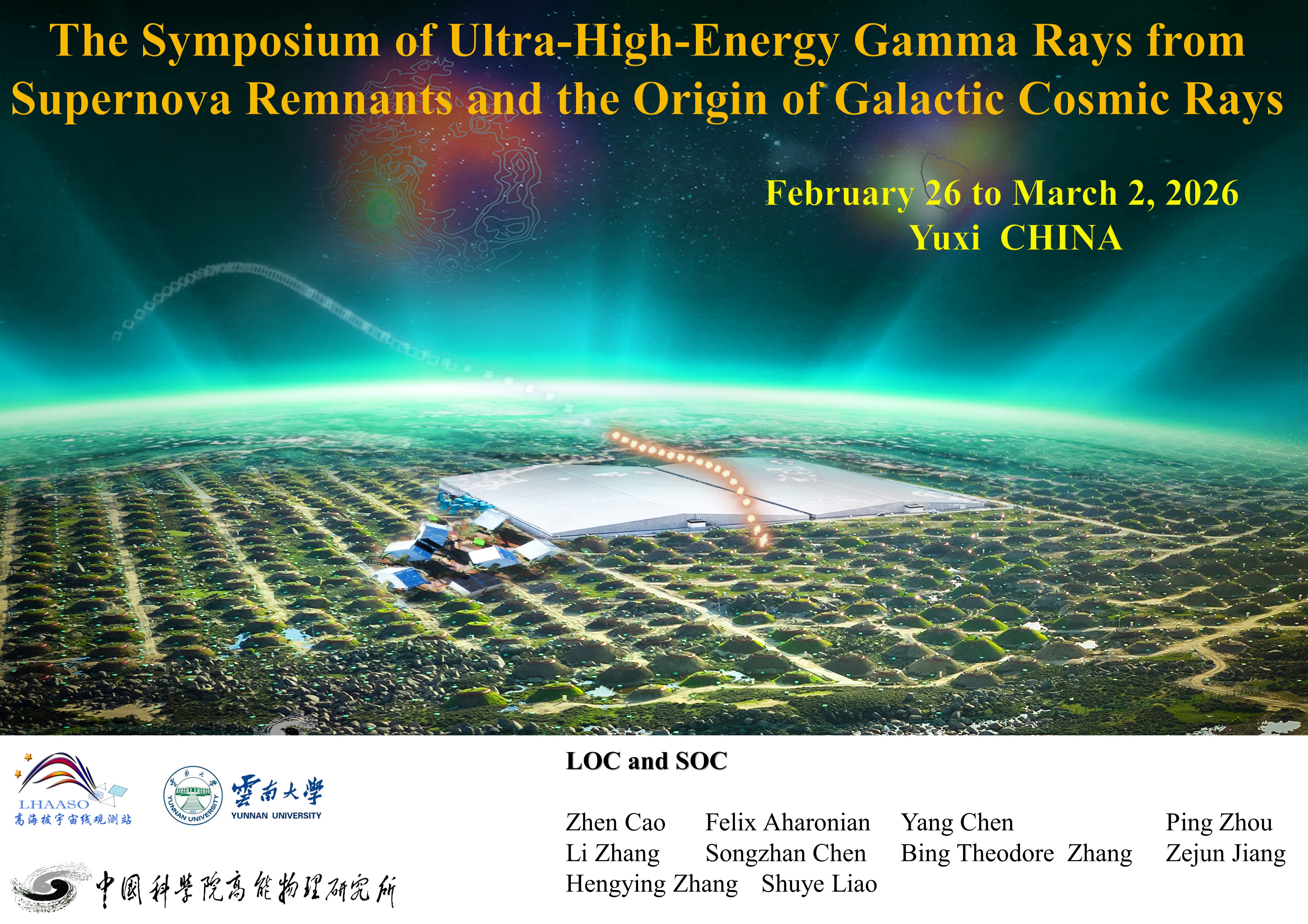
The Symposium of Ultra-High-Energy Gamma Rays from Supernova Remnants and the Origin of Galactic Cosmic Rays
Chengjiang, Yuxi, Yunnan Province, China
Supernova remnants (SNRs) have long been considered the dominant sources of Galactic cosmic rays (CRs), supported by energetic arguments and the paradigm of the diffusive shock acceleration (DSA) as a robust particle-acceleration mechanism. Over the past two decades, observations of TeV gamma rays and nonthermal X-rays from many young SNRs have confirmed that these systems with significant magnetic amplification can accelerate particles to beyond 1 TeV. At the same time, these measurements revealed unexpectedly steep spectra at multi-TeV energies. The lack of ultra-high-energy (UHE; E>100 TeV) gamma-ray detections by LHAASO for any young SNR has initiated debates over whether SNRs can truly act as PeVatrons capable of supplying CRs around and above the knee.
However, the observed spectral steepening does not necessarily imply early cutoffs (below the "knee") in the parent particle distributions. Recently recognised new features of DSA, along with current detectors' sensitivity limitations, may still allow young SNRs to reach PeV energies. Moreover, the detections of UHE gamma rays from dense environments around several middle-aged SNRs - interpreted as "smoking-gun" signatures of CR interactions with nearby gas complexes - provide indirect but relatively strong evidence that these SNRs may have operated as PeVatrons tens of thousands of years ago. Understanding the origin of UHE gamma-ray emission also benefits from coordinated multi-wavelength efforts that combine gamma-ray, X-ray, millimeter, and radio observations to disentangle the roles of particle acceleration, ambient conditions, and the SNR properties.
This workshop aims to bring together experts in CR physics and SNR research to examine the implications of UHE gamma-ray observations of both young and middle-aged SNRs. Using multi-wavelength data from SNRs and their environments, participants will explore competing interpretations, assess the physical conditions required for PeVatron activity, and discuss the broader consequences for the origin of Galactic cosmic rays.
We invite interested researchers to join us for an in-depth, collaborative discussion of this central question in cosmic-ray astrophysics.
Andrea Giuliani
Andrew Taylor
Benzhong Dai
Bing Liu
Bing Theodore Zhang
Bingqiang Qiao
Biping Gong
Bohan 博涵 Xie 谢
Chaoming Li
Chen Huang
Cong Li
dahai yan
Emma de Ona Wilhelmi
Ensheng Chen
Felix Aharonian
Fengrong Zhu
gang cao
Hengying Zhang
Hidetoshi Sano
Houdun Zeng
Huihai He
Jun Fang
Li Zhang
Min Zha
Ping Zhou
Qiqi Jiang
Qizuo Wu
Razmik Mirzoyan
Ruizhi Yang
Ruoyu Liu
Sabrina Casanova
Sarah Recchia
Sha WU
Shao-qiang xi
SHICONG HU
Shoushan Zhang
Silvia Celli
Siming Liu
songzhan(松战) CHEN(陈)
Tian-Ci Zheng
Xiao ZHANG
Xiao-Jun Bi
Xiaohui Sun
Xin Zhou
Xiying Zhang
Yang Chen
YU QING LOU
Zhen Cao
Zhuo Li
一楠 吴
嘉旭 孙
建立 张
暑业 廖
泽军 姜
碧玉 太
蕴之 沈
陈 姿伊
雄帮 杨
韬 文