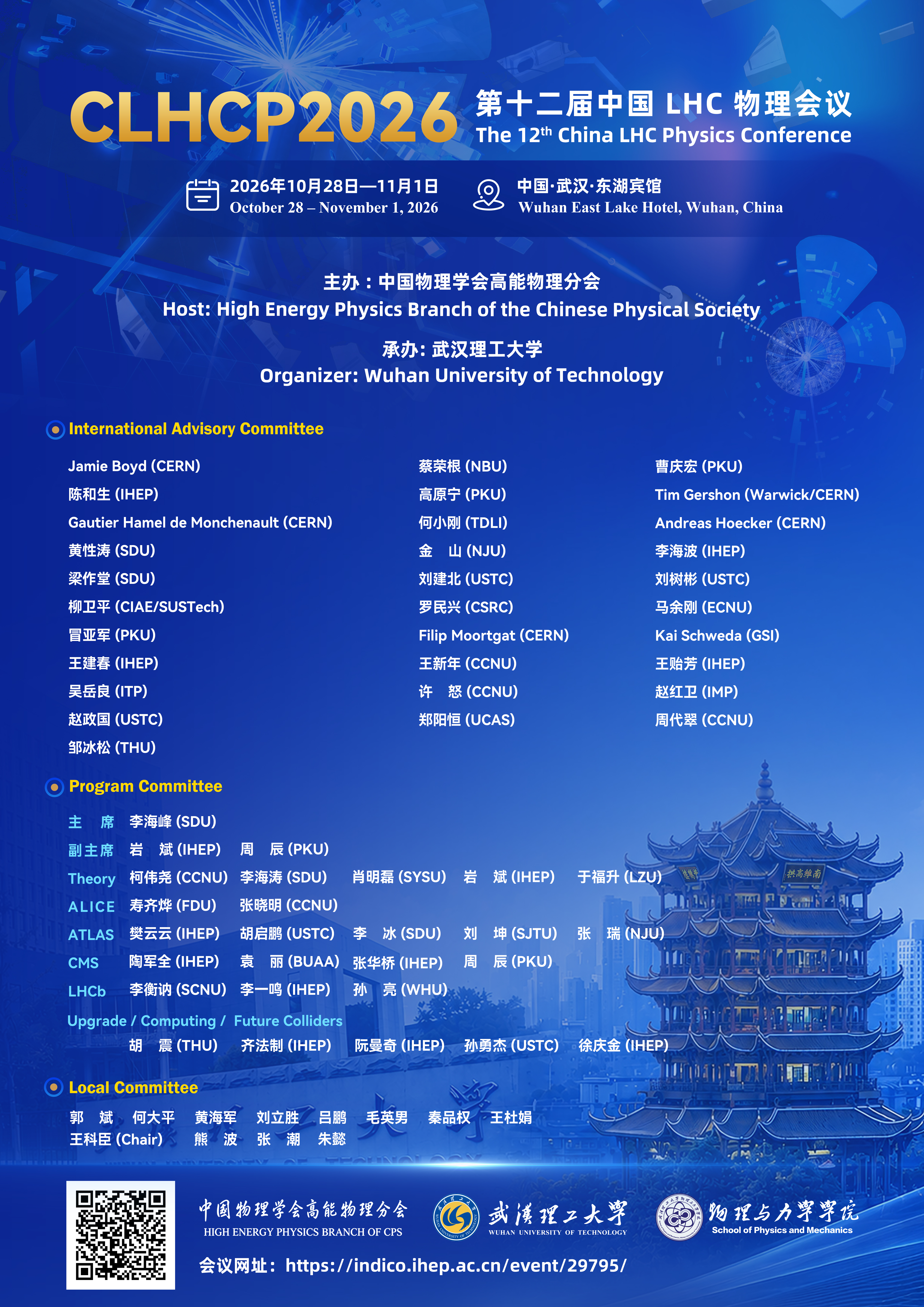
第十二届中国 LHC 物理会议(CLHCP2026)
湖北省武汉市 (Wuhan, Hubei)
The 12th China LHC Physics Conference (CLHCP2026)
Dear Colleagues,
The 12th China LHC Physics Conference (CLHCP2026) will be hosted by the High Energy Physics Branch of the Chinese Physical Society, organized by Wuhan University of Technology, with local organization by the School of Physics and Mechanics, Wuhan University of Technology. The conference will take place from October 28 to November 2, 2026 (registration on October 28, departure on November 2) at Wuhan East Lake Hotel, Wuhan, China. Beginning from October 30, we have live broadcast through Koushare for all other plenary talks (see the link https://www.koushare.com/live/details/56879 ).
About CLHCP
The China LHC Physics Conference (CLHCP) is a significant national academic conference led by the High Energy Physics Branch of the Chinese Physical Society. It focuses on the latest research progress in the frontiers of particle physics experiments and theories related to high energy and high precision.
Topics of the conference include Higgs physics, electroweak physics, hadron physics and flavor physics, heavy ion physics, new physics beyond the Standard Model, detector and accelerator technology, and other important foundational research topics in high-energy and high-precision particle physics.
The conference aims to enhance communication and collaboration between theoretical physicists and experimental physicists in the frontiers of high energy, high precision, and experimental technology, promote the collective advancement of particle physics research in China, enhance the international academic impact of related research, and provide a platform for young scholars to engage in exchange and collaboration.
The organizing committee cordially invites you to participate in CLHCP2026!
Registration & Payment
Conference registration and abstract submission are now open.
Registration fee:
- Faculty, Research Staff & Postdoctoral Researchers: RMB 2,000
- Student: RMB 1,500
The registration deadline is October 18, 2026. Registered participants may update their registration information through “Manage my registration” until October 25, 2026.
Conference registration is completed through Indico. After completing the registration, participants who are required to pay the registration fee should make payment through Aconf using the same name and email address as in their Indico registration (through this link https://www.aconf.cn/conf_228753.html ). Detailed payment and invoice instructions are provided in the registration form and confirmation email. Please join the following WeiXin Group after your registration through the invitation of volunteers at the registration desk.
Abstract Submission & Conference Talks
Abstract submission is now open. The submission deadline for theory parallel-session talks and poster abstracts is October 8, 2026.
- Plenary talks: invited separately by the Program Committee.
- Theory parallel-session talks: please submit an abstract through the Call for Abstracts page and select Theory as the Track.
- Poster presentations: please submit an abstract through the Call for Abstracts page and select Poster as the Track.
- Experimental parallel-session oral talks: please contact the corresponding Program Committee members of the relevant experimental collaboration.
Unless specifically instructed by the Program Committee, please do not select other Tracks when submitting an abstract through the public Call for Abstracts.
Only the four plenary talks about progresses of ATLAS/CMS/LHCb/ALICE collaborations will be given in Chinese, while all other plenary and parallel talks should be given in English.
Practical Information
Venue, accommodation and transportation information is available on the following pages:
Information on the timetable and other conference arrangements will be updated on this website as preparations progress. Please follow future announcements for the latest information.
Contact
Email: CLHCP2026@whut.edu.cn
Conference Services: +86 185 7163 4429
Registration & General Enquiries: Ying-nan Mao, +86 181 6252 1061
第十二届中国 LHC 物理会议(CLHCP2026)
尊敬的各位专家学者:
2026年第十二届中国 LHC 物理会议 The 12th China LHC Physics Conference (CLHCP2026) 由中国物理学会高能物理分会主办,武汉理工大学承办,武汉理工大学物理与力学学院负责地方组织。会议日期为2026年10月28日至11月2日(10月28日报到,11月2日离会),会议地点为武汉东湖宾馆。从10月30日起,大会报告都将通过蔻享平台同步直播(见链接 https://www.koushare.com/live/details/56879 )。
关于 CLHCP
中国 LHC 物理会议(简称 CLHCP)是由中国物理学会高能物理分会牵头的全国性重要学术会议,聚焦于高能量与高精度前沿粒子物理实验与理论的最新研究进展,会议内容包括:希格斯物理、电弱物理、强子物理与味物理、重离子物理、超越标准模型的新物理、探测器与加速器技术等粒子物理高能量与高精度前沿重要基础研究热点方向。
会议旨在加强理论物理学家及实验物理学家在高能量前沿、高精度前沿与实验技术前沿领域的交流与合作,引领粒子物理领域国内研究水平的共同进步、推动国内相关研究工作的国际学术影响力、为年轻学者提供交流与合作的舞台。
会议组委会诚挚邀请各位专家学者参加 CLHCP2026!
会议注册及缴费
会议注册和摘要提交现已开放。
注册费标准:
- 教师、科研人员及博士后:人民币 2,000 元
- 学生:人民币 1,500 元
会议注册截止日期为 2026 年 10 月 18 日。已注册人员可通过 “Manage my registration” 截至 2026 年 10 月 25 日更新注册信息。
会议正式注册统一通过 Indico 完成。完成会议注册后,需要缴纳注册费的参会代表请通过艾会网(Aconf)缴费,并使用与 Indico 注册信息一致的姓名和邮箱(网址 https://www.aconf.cn/conf_228753.html )。具体缴费及发票申请说明见注册表和注册确认邮件。请完成注册的老师和同学加入如下微信群(由于群成员总数已超过200人,二维码进群的方式已经失效,请尚未进群的老师和同学通过注册台的值班志愿者或任何已进群好友的邀请入群)。
摘要提交及会议报告
摘要提交现已开放。 理论分会报告及墙报摘要提交截止日期为 2026 年 10 月 8 日。
- 大会报告:由 Program Committee 单独邀请。
- 理论分会报告:请通过 Call for Abstracts 页面提交摘要,并在 Track 中选择 Theory。
- 墙报:请通过 Call for Abstracts 页面提交摘要,并在 Track 中选择 Poster。
- 实验分会口头报告:请联系相应实验合作组对应的 Program Committee 成员协调。
除非收到 Program Committee 的明确通知,通过公开 Call for Abstracts 页面提交摘要时请勿选择其他 Track。
除第一天上午ATLAS/CMS/LHCb/ALICE合作组的进展报告用中文进行外,其他所有大会和分会报告都需要使用英文。
会务信息
会场、住宿和交通信息已经发布,请通过以下页面查看:
会议日程及其他安排将根据筹备进展在本网站持续更新,请关注后续通知。
联系方式
统一邮箱: CLHCP2026@whut.edu.cn
会务服务: 杨真林,185 7163 4429
注册与综合咨询: 毛英男,181 6252 1061
Andrew Levin
Antonio De Maria
Ayesha Zainab
Ben-Wei Zhang
Bin Yan
Bingxuan Liu
Bo Liu
Boan Shi
Bohan Ren
Boyang Gao
Bo(波) Xiong(熊)
Canming Li
Chang-Qi Hu
Chengxin Liao
Chenxi Fu
Chen(辰) Zhou(周)
Chong-Xing Yue
Chonghao Wu
Chunjian Zhang
Congqiao Li
Daicui Zhou
Daimei Zhou
DaiXing Zhang
Daping He
Dayong Wang
dazhuang he
Dieter Röhrich
Eva Didier-Esteve
François Sylvain René LAGARDE
Haibo LI
Haidar Mas'ud Alfanda
Haijun Huang
Haijun Yang
Haitao Li
Hanbing Liu
Hang Yin
Hao Cai
Haoran Bao
Henryk Giemza
Hideki (英希) OKAWA (大川)
Hongbo LIAO
Hongjuan Xu
Honglei Li
Hongtao Yang
Huaqiao ZHANG
Jia-Jie Han
Jia-Le Ding
Jiajun Qin
Jian Wang
Jian-Nan Ding
Jianchun Wang
Jiangyong Jia
Jianhui Zhu
Jianqiao Deng
Jiaxuan Li
Jiayin Gu
Jiayu Yuan
Jie Gao
Jie Yi
Jike Wang
Jin Wang
Jin Wang
Jing Dong
Jingbo Geng
Jingqing Zhang
Jingwei Lian
Jingya ZHU
JIngyan Shi
Jinjing Gu
Jinkang Peng
Jinlong Zhang
Joao Guimaraes da Costa
Jun Gao
Jun Guo
Jun Zeng
Junjie Cao
Junle Pei
Junlee Kim
Junquan (军全) TAO (陶)
Kang Liu
Kegang Xiong
Kun Liu
Kwansan Wang
Li Yuan
Liang Sun
Liangchen Liu
Lianliang MA
Ligang Xia
Liming Zhang
Lin Chen
Lin Yang
Lin Yang
Linjing Duan
Linrui Chen
Liupan An
Long Wang
Longsheng Tan
Maolin Zhang
Matthias Tartarin
Mei Zhao
Meijian Li
Min Tang
Ming Zeng
Ming-Lei Xiao
Mingjie Jin
Mingqian SHEN
Mingrui Zhao
Mingshui CHEN
Mingyang Zhu
Mohan Pi
Mourad Hidaoui
MUSTAPHA BIYABI
Muyuan Zhou
NING CHEN
Peilian Li
Praveen Chandra Tiwari
Qi-Shu Yan
Qiang Li
Qianrou Li
Qianyuan ZHAO
qiaomu tong
Qing Ai
Qing-Song Chang
Qingjin XU
Qipeng Hu
Rabia Hameed
Reda Mekouar
RIA SAIN
Ryotaro Watanabe
Shan Jin
Shanzhen Chen
Shenghan Mao
Shi-Bei Kong
Shiqi Wang
Shiyi Liang 梁诗怡
Shoulong Lin
Shu Li
Shu-Lei Zhang
Shu-Tao Zhang
Shu-Yi (树一) Wei (魏)
Shuai Yang
Shuang Yang
Shuangbing Song
Shuangyuan Wang
Shuo Han
Shuyu Han
Si-Yu Zhang
Sijing Zhang
Teng Ma
Tianjun Li
Vincent Shang
Vincenzo Vagnoni
Vladimir Sergeychik
Wei Chao
Wei Su
Wei-Ning Zhang
Wei-Tian Deng
Weiguo卫国 Lu陆
Wei(刘威) Liu
Wen Qi Wang
Wenxuan luo
Xiang Li
Xiangyu Wu
Xiao Han
Xiao Yu
Xiao-Gang He
Xiaobo Jin
Xiaofan Pan
Xiaolin Kang
Xiaomin Wei
Xiaonan Li
Xiaotian Ma
Xiaowei JIANG Xiaowei
Xin Shi
Xin-Qiang Li
Xing-Bo (兴博) Yuan (袁)
xinye peng
Xu(旭) Wang(王)
XuAi ZHUANG
Xufei Xue
Yajun Mao
Yanbing Wei
Yang Liu
Yang Zhang
Yanlin (彦麟) Liu (刘)
Yanping Huang
Yanwen Liu
Yaodong Cheng
Yaxian Mao
Yazhen Lin
Ye Chen
Yi Liu
Yifei Chen
Yihang Gao
Yiming 一鸣 Li 李
Ying-nan Mao
Yinghua Tan
Yingzhe Wang
Yixiang Zhang
Yixin Fan
Yongjie Sun
Yu Gao
Yu Zhang
Yu-Qi Xiao
Yuanning Gao
Yuchen Sun
Yue Chang
yuehong Xie
Yuexin Ding
Yufei Chen
Yuhang Cao
Yuhao Wang
yulong tang
Yunyun Fan(樊云云)
Yusheng Wu
Yuxi Gao
Zehua Xu
Zekai Feng
Zeren Simon (泽人) Wang (王)
Zhen Hu
Zhen-Hua (振华) Zhang (张)
Zhengyu li
ZhenYang(振洋) Wang(王)
Zhewei Yin
Zhi-Hui Guo
Zhiguo He
Zhihe HAN
Zhihong He
Zhilang Wang
Zhilei SHE
Zhiyang Yuan
Zhiyong Lu
Zhiyong Ye
Zhiyu Xiang
Zhong Shuo Yang
zhong zhang
Zhongbao Yin
Zihang Liu
Zihang Wang
zihao Wang
zihao Wang
zijun zhao
Ziqian Zhou
一品 王
万炳 罗
为松 段
丽燕 金
乐凯 姚
云帆 刘
亚东 何
亚东 杨
京周 赵
亮 Liang 李 Li
任杰 王
伟尧 (Weiyao) 柯 (Ke)
伯强 卢
佳慧 武
俊 华
俊 王
俊锋 王
傲昇 熊
傲楠 王
兰 王
冰 李
利娜 吴
千禧 李
升浩 张
南洋 王
博新 王
召丰 康
可平 谢
可陈 李
叶 陆
品权 秦
善贵 周
嘉轩 申
嘉龙 胡
国强 郑
圣奇 张
圣沛 王
圣逸 胡
圳君 熊
坤 胡
坤林 冉
培森 马
大为 付
天宇 史
天歌/tiange 李/li
天骁 胡
如梦 潘
娇娇 冯
媛婧 纪
嬿 王
子凡 李
子承 王
子江 王
子瑞 Zirui 王 Wang
子骏 徐
子龙 丁
存峰 冯
安琪 王
宗晟 何
宗欢 段
宠 刘
家威(Jiawei) 万(Wan)
家荣 袁
宸 傅
富淳 崔
小康 都
小虎 孙
展航 周
山家 刘
屹立 王
岑 莫
嵘 范
帆 胡
希媛 张
康 虞
建英 钱
张奇尔 王
彬 刁
得洋 龙
德胜 李
德良 姚
志嘉 孙
志均 梁
志清 张
志鹏 邢
思洋 王
怡平 王
惠超 刘
想 李
慧 张
慧玲 华
懿 朱
扬 (Yang) 周 (Zhou)
振伟 杨
政国 赵
文 陈
文文 谢
文昊 马
文杰 时
文静 王
斌 郭
新 陈
新年(Xin-Nian) 王(Wang)
新月 耿
新锴 / Xin-Kai 文 / Wen
早晨/Zaochen 叶/Ye
昆鹏 余
昊昱 刘
明依 刘
明宇 张
星宇 吴
星昱 童
晓会 胡
晓健 杜
晓峰 罗
晓明 张
晓智 白
晓民 沈
晓飞 闫
晨曦 温
晨风 段
暄 陈
曈光 成
月新 刘
月晟 代
朝峰 刘
朦 肖
杜娟(Dujuan) 王(Wang)
森杰 朱
楮文 肖
欣 罗
殿威 马
泽方 江
泽清 牟
洁晟 俞
海峰 李
海波 (Hai-Bo Li)李
涛 李
涛 罗
漪林 周
潮 张
煜 汤
煦昊 袁
玉敬 金
玉江 毕
瑞(Rui) 张(Zhang)
瑞卿 肖
璐 高
皓天 祁
盛麟 柳
睿棋 郑
磊毅 李
祉瑞 王
祥 赵
祥 钟
秋茹 白
科臣 (Kechen) 王 (Wang)
积森 李
立胜 刘
红 高
纪峰 邓
绪开 匡
维杰 刘
翔鹏 王
聪聪 王
航 杨
艳席 张
芝田 邹
茵 李
莉 姬
衡讷 李
诗洋 陈
赞 任
超 邬
路 郑
路 郑
路 韩
轶旻 车
辽珊 石
野 邹
金林 傅
鑫鑫 祁
钱 杨
铭滔 张
铸丁 段
锐 周
雨超 朱
雲相辉 王
雷 赵
雷(Lei) 张(Zhang)
震 匡
震 张
青霖 李
青青 张
静雯 丁
鹏 吕
鹏 张
齐烨 寿
龙刚 庞
-
-
09:00
→
18:00
Registration 会议中心三号门大厅
会议中心三号门大厅
-
18:00
→
20:00
Dinner 2h 黄鹂厅
黄鹂厅
-
09:00
→
18:00
-
-
08:30
→
08:55
开幕式 黄鹤厅
黄鹤厅
Convener: 刘立胜-
08:30
武汉理工大学校领导致欢迎辞 10m
-
08:40
中国物理学会高能物理分会致辞 10mSpeaker: 高原宁
- 08:50
-
08:30
-
08:55
→
09:55
Plenary - I 黄鹤厅
黄鹤厅
Convener: 赵政国- 08:55
-
09:15
CMS进展 20mSpeaker: Zaochen Ye (South China Normal University)
- 09:35
-
09:55
→
10:25
Photo and Coffee Break 30m 会议中心
会议中心
-
10:25
→
12:00
Plenary - II 黄鹤厅
黄鹤厅
Convener: 梁作堂- 10:25
-
10:45
Eletroweak physics from ATLAS amd CMS 25mSpeaker: 梁志均
-
11:10
CP violation in B decays at LHCb 25m
In this talk, I will present the latest results on CP violation in B-hadron decays from LHCb.
Speaker: Hang Yin - 11:35
-
12:00
→
13:30
Lunch 1h 30m 黄鹂厅
黄鹂厅
-
13:30
→
18:30
NSFC-CERN 专项 2026 年度交流暨学术研讨会(中文会议) 荆州厅
荆州厅
-
13:30
开幕式 20m 荆州厅
荆州厅
-
13:50
项目进展报告 4h 40m 荆州厅
荆州厅
-
13:30
-
14:00
→
18:00
Poster 会议中心
会议中心
-
14:00
Research Progress of LGAD Detectors for ATLAS Luminosity Monitoring 2m
"With the High-Luminosity Large Hadron Collider (HL-LHC) upgrade, the instantaneous luminosity will increase by almost an order of magnitude, reaching levels of up to (7.5\times10^{34}\ \mathrm{cm^{-2}s^{-1}}). This will lead to a substantial growth in the average pile-up density, with an expected average number of simultaneous proton-proton collisions per bunch crossing of approximately (\mu_b \approx 200), as well as a significantly harsher radiation environment in the forward region. These conditions impose extreme requirements on both the radiation hardness of the detector sensors and the precision and robustness of luminosity measurements.
a novel ATLAS Beam Monitoring Apparatus (BMA) has been specifically designed to perform precise and robust luminosity measurements under the demanding HL-LHC conditions. The BMA exploits the timing and counting capabilities of LGAD detectors to provide complementary and independent luminosity calibration, offering high segmentation, fast response, and intrinsic radiation tolerance.
This talk presents the research progress of LGAD detectors for the ATLAS BMA applications. In particular, we will report on the laboratory characterisation of the IHEP LGAD sensors developed for the ATLAS BMA luminosity monitoring, including static electrical performance, charge collection, and radiation hardness studies. Furthermore, we will describe the experimental setup, bias voltage tuning mothed and the luminosity measurement results obtained during beam tests conducted at CERN over the period from 2025 to 2026. The performance of the sensors in a real beam environment and the implications for luminosity monitoring under HL-LHC operating conditions will be discussed."Speaker: Mei Zhao -
14:02
Boosted Xbb tagger algorithm and calibration at ATLAS 2m
Identifying highly Lorentz-boosted Higgs bosons decaying to bottom-quark pairs is essential to the ATLAS physics programme. This poster reviews the evolution of boosted $X\to b\bar{b}$ tagging in ATLAS and the development of the corresponding calibration strategies. The Run-2 $D_{\rm Xbb}$ algorithm combined large-$R$-jet kinematics with flavour-tagging information from variable-radius track jets in a feed-forward neural network. GN2X introduced a transformer architecture that directly processes charged-particle tracks associated with the large-$R$ jet, improving the discrimination of $H\to b\bar{b}$ and $H\to c\bar{c}$ decays from top-quark and multijet backgrounds. The latest development, GN3X, further advances transformer-based identification of boosted Higgs bosons. Alongside this algorithmic evolution, we present the calibration methodology being developed for these taggers. The programme includes the extraction of signal-efficiency scale factors using $Z\to b\bar{b}+\mathrm{jets}$ events, dedicated studies of background mis-tag efficiencies and modelling, and investigations of dependencies on flavour composition and jet topology. Generator- and process-dependent differences are evaluated through MC-to-MC efficiency maps, which provide corrections for applying calibrations across simulated samples.Together, these developments aim to provide robust boosted-$H\to b\bar{b}$ identification for ATLAS Run-2 and Run-3 analyses.
Speaker: 虞康 -
14:04
Improvement of photon identification measurement with normalization flow in ATLAS experiment 2m
Accurate photon identification efficiency measurements are essential for physics analyses with photons at the ATLAS experiment. This poster presents a normalising-flow-based electron-extrapolation method for unconverted photons, with an application to 2022 collision data. A conditional normalising flow trained on simulated electrons and photons transforms the joint distribution of calorimeter shower-shape observables, accounting for their correlations. The learned transformation is then applied to electrons selected from $(Z\to e^+e^-)$ decays to estimate the photon identification efficiency.
Speaker: Lin Yang -
14:06
A Skill-Based Agent Workflow for Deploying and Validating Machine Learning Models on FPGAs 2m
"High-energy physics experiments are increasingly using FPGAs to deploy machine learning models for low-latency triggering and real-time data processing. Deploying these models on FPGAs requires coordinating several software and hardware tools. We present an agent workflow using reusable skills to support this process. The agent coordinates model conversion, hardware builds, and on-board testing, while scripts execute the tasks and check the results.
We have used the workflow to deploy multiple models on two FPGA boards. Initial validation includes comparisons with software reference outputs and checks of resource use and timing. Further work will test consistency across boards and independent reproduction, and compare the workflow with a generic agent to evaluate deployment success, execution time, and the need for human intervention."
Speaker: 王子承 -
14:08
HGTD ASIC Wafer Probing for the ATLAS Phase-II upgrade 2m
"The High-Luminosity LHC (HL-LHC) will deliver instantaneous luminosities up to $7.5 \times 10^{34}~\rm{cm}^{-2}\rm{s}^{-1}$, resulting in an average of $200$ pile-up interactions per bunch crossing. This poses a serious challenge for the ATLAS detector, particularly in the forward region where detector granularity is reduced. To address this, the High-Granularity Timing Detector (HGTD) will be installed in the pseudorapidity range from $2.4$ to $4.0$, augmenting the new all-silicon Inner Tracker (ITk) with precise timing information to distinguish between collisions close in space but separated in time. Based on Low-Gain Avalanche Detector (LGAD) technology, the HGTD will comprise two double-sided layers with a readout cell size of $1.3 \times 1.3~\rm{mm}^{2}$, resulting in approximately $3.7$ million channels. The detector will provide a timing resolution of $30$ ps per track at the start of HL-LHC operations and $50$ ps at the end, enabling pile-up mitigation, correct vertex assignment, and bunch-by-bunch luminosity measurements.
The readout is based on the ALTIROC-A ASIC, a 225-channel front-end chip fabricated in a $130~\rm{nm}$ CMOS process. The large-scale production of the HGTD requires approximately $27,000$ ASICs, making wafer-level screening a critical step before dicing and module assembly.
This poster presents the wafer probing campaign for the ALTIROC-A ASIC, including the dedicated acquisition system, the testing procedure, and the results obtained for the pre-production phase. In the current campaign, $46$ wafers have been probed, achieving a high yield under the established acceptance criteria. These results are instrumental in defining robust screening rules and establishing a production-oriented framework for the large-scale quality control of ALTIROC-A ASICs."
Speakers: Haidar Mas, ud Alfanda -
14:10
Power Simulation and Diagnostic Testing for ATLAS HGTD Peripheral Electronics Board 2m
The High-Granularity Timing Detector (HGTD) will provide precise timing information to mitigate pile-up effects in the ATLAS Phase-II upgrade. The Peripheral Electronics Board (PEB) interfaces front-end modules with off-detector systems, providing power distribution, data aggregation, control and monitoring. This work presents power-plane simulations and the development of a Diagnostic Test Module (DTM) for PEB qualification. Static IR-drop simulations of the PEB 3F design cover 30 analog and digital power planes serving 39 front-end module connectors, with a load of 1 A per connector. Power-plane optimization reduces the high-resistance tail, bringing the vast majority of simulated power-path resistances below 10 mΩ. The DTM replaces a front-end module with matching mechanical dimensions and connectors, providing connectivity checks, supply-voltage monitoring and thermal load emulation. It supports production testing, cooling validation and slow-control calibration under representative operating conditions.
Speaker: 万家威 -
14:12
Merged Electron ID/Performance and application in low mass resonance reconstructions at ATLAS 2m
"In $H\to\gamma^*\gamma\to ee\gamma$ decays, low-mass electron pairs with high transverse momentum can produce overlapping electromagnetic showers in the calorimeter. A single cluster matched to two opposite-charge tracks forms a merged dielectron candidate, requiring dedicated identification to retain signal and reject photon and jet backgrounds. This poster presents merged dielectron identification and performance at ATLAS and its application to $H\to\gamma^*\gamma$.
In Run 2, merged dielectrons were identified using a cut-based method. In Run 3, a boosted decision tree (BDT) is trained to distinguish signal merged dielectrons from photon and jet backgrounds. It combines standard electron-identification shower-shape variables with track-to-calorimeter pointing variables. Training uses simulated $H\to\gamma^*\gamma$ signal samples, Jet Filter background samples and $H\to\gamma\gamma$ background samples. To improve data-MC agreement, simulated shower-shape variables are corrected using converted-photon fudge factors. Background $p_{\mathrm{T}}$ and $\eta$ distributions are reweighted to match the signal, preventing the classifier from exploiting kinematic differences.
At the same background efficiency as the Run 2 identification, the simulated signal efficiency increases from approximately 62% to 90%, allowing more signal candidates to be retained. To evaluate the efficiency in data, converted photons from $Z\to\ell\ell\gamma$ decays are used as a proxy for merged dielectrons. A simultaneous fit in signal and control regions accounts for residual background. Comparing the extracted efficiency with simulation provides data-to-MC scale factors and uncertainties.
The identification is applied to the ATLAS $H\to\ell\ell\gamma$ measurement with $m_{\ell\ell}<30\,\mathrm{GeV}$, using $164\,\mathrm{fb}^{-1}$ of $pp$ collision data at $\sqrt{s}=13.6\,\mathrm{TeV}$. At the same cross-section and luminosity, it improves the overall expected significance by 5% relative to the Run 2 identification."
Speaker: Linjing Duan -
14:14
Improved analysis of non-resonant Higgs boson pair production in the bbtautau final state with data collected at = 13 TeV and 13.6 TeV with the ATLAS detector 2m
A search for non-resonant Higgs boson pair production ($HH$) in the $b\bar{b}\tau^+\tau^-$ final state is performed using $140$~fb$^{-1}$ and $56$~fb$^{-1}$ of proton--proton collision data at centre-of-mass energies of $\sqrt{s} = 13$~\TeV and $13.6$~\TeV, respectively, recorded by the ATLAS detector during 2015--2023 at the CERN Large Hadron Collider. Relative to the previous ATLAS searches in the same final state, the analysis benefits from the additional dataset collected at 13.6 \TeV and from improvements in both event reconstruction and analysis techniques. The Higgs boson pair production cross-section divided by the Standard Model (SM) prediction is found to be $\mu_{HH}= 2.6^{+1.4}_{-1.0}$, consistent with the SM expectation. This corresponds to an observed (expected) significance of $2.6$ ($1.2$) standard deviations over the background-only hypothesis of no $HH$ production and 1.65 standard deviations with respect to the SM prediction. Under the assumption that all other Higgs boson couplings take their SM values, the observed (expected) 95\% confidence level interval for the Higgs boson self-coupling modifier is found to be $\kappa_{\lambda} \in [-3.4, 1.6] \cup [5.5, 10.1]$ ($\kappa_{\lambda} \in[-1.7, 8.5]$). As a validation of the analysis strategy, measurements of the $ZH$ and $ZZ$ processes are performed in the same final state using the same event selection, yielding observed (expected) significances of 3.5 (2.4) and 1.8 (2.7) standard deviations, respectively, relative to the background-only prediction.
Speaker: Yimin Che -
14:16
Mass-Decorrelated Event Classifier Transformer for the ATLAS Run 3 H → Zγ Analysis 2m
"Effective event categorization is essential for improving the sensitivity of the H → Zγ analysis. Correlations between classifier outputs and the reconstructed Zγ invariant mass can distort background distributions and complicate signal extraction. This poster presents the application of a mass-decorrelated event classifier transformer to the ATLAS Run 3 H → Zγ analysis, focusing on the Z → ℓ⁺ℓ⁻ final state, where ℓ = e or μ.
The approach combines a transformer architecture with distance correlation (DisCo) regularization to achieve signal–background discrimination while suppressing mass correlations. Studies using ATLAS Run 3 simulated samples and categories defined by the ratio of photon transverse momentum to Zγ invariant mass. Preliminary results show improved discrimination in the latter categories and smoother background mass distributions after classifier-based selection. Background-modeling studies also indicate reduced spurious-signal contributions in several categories and the applicability of simpler fit functions in some cases. These findings highlight the potential of DisCo Transformers for event categorization with better control of background mass shapes and motivate further development toward the full Run 3 analysis."
Speaker: Xiang Li -
14:18
X(3872) in Run 3 Pb-Pb data 2mSpeaker: 姚乐凯
-
14:20
CP violation in charm sector at CMS experiment 2mSpeaker: Vladimir Sergeychik
-
14:22
Probing the Higgs Self-Coupling through Off-Shell Higgs Production in the Four-Lepton Final State 3mSpeaker: Longsheng Tan
-
14:00
-
17:30
→
20:00
Dinner 2h 30m 黄鹂厅
黄鹂厅
-
19:30
→
20:30
LHCb闭门会议 神农架厅
神农架厅
-
19:30
→
21:00
Public lecture 西院会议中心301报告厅
西院会议中心301报告厅
Convener: 梁作堂-
19:30
自旋轨道耦合与重离子碰撞自旋物理 1h 30m
蔻享直播链接 https://www.koushare.com/live/details/57221
Speaker: 梁作堂
-
19:30
-
20:00
→
21:00
ATLAS闭门会议 天门厅
天门厅
-
08:30
→
08:55
-
-
08:30
→
10:10
Plenary - III 黄鹤厅
黄鹤厅
Convener: 罗民兴- 08:30
-
08:55
Higgs self-coupling 25m
This talk presents an overview of recent measurements on the Higgs boson self-coupling from the ATLAS and CMS experiments. It also discusses their theoretical interpretation and the projected sensitivity at the HL-LHC.
Speaker: 冉坤林 -
09:20
Rare and Exotic Higgs 25m
Rare and exotic decays of the Higgs boson offer a unique window into phenomena beyond the Standard Model, probing potential new interactions, hidden sectors, and extended Higgs sectors.This talk will review the latest searches for rare and non-standard Higgs decays performed by the ATLAS and CMS experiments.
Speaker: 刘彦麟 (山东大学) -
09:45
Scattering-Amplitude Methods in Effective Field Theory 25m
On-shell amplitudes reveal the independent interactions of effective field theory (EFT), complementing redundant Lagrangian descriptions. This review follows the on-shell approach from kinematics, factorization, recursion, and soft constraints to nonredundant massless and massive amplitude bases. We discuss harmonic analysis, Young tableaux, and massive spinor-helicity methods, emphasizing minimal-dimension bases, on-shell Higgsing, the relation between Standard Model EFT and Higgs EFT, and static–recoil power counting. We then review matching, renormalization group evolution, and partial-wave selection rules, including the regulated and evanescent information required beyond four-dimensional physical bases. Applications to colliders, compact-object dynamics and radiation, positivity, and numerical bootstrap bounds connect local amplitudes to observables and ultraviolet consistency. Throughout, we distinguish basis construction, regulated calculations, and physical projections while clarifying their connections, providing a systematic route from independent EFT interactions to phenomenology and ultraviolet constraints.
Speaker: 马 腾
-
10:10
→
10:30
Coffee break 20m
-
10:30
→
12:10
Plenary - IV 黄鹤厅
黄鹤厅
Convener: 李 田军- 10:30
-
10:55
Highlights of QCD results from ATLAS and CMS 25mSpeaker: Yusheng Wu (University of Science and Technology of China)
- 11:20
-
11:45
Single inclusive hadron production from the LHC to CEPC and EIC 25m
TBD
Speaker: Jun Gao (Shanghai Jiao Tong University)
-
12:10
→
13:30
Lunch 1h 20m 黄鹂厅
黄鹂厅
-
14:00
→
16:00
Parallel 1: Higgs 1 天门厅
天门厅
Convener: 肖朦-
14:00
Run2 Hgg mass measurement and width constraint at CMS 15m
This talk will present the latest results of Higgs mass measurement and width constraint in the diphoton final state at CMS
Speaker: Junquan (军全) TAO (陶) (IHEP/CAS (中科院高能所)) -
14:15
CMS Hgg and HZZ mass combination(online) 15m
The latest results of Hgg and HZZ mass combination will be presented
腾讯会议:870-930-901
Speaker: Chenguang Zhang -
14:30
Combination of Higgs Boson Measurements and Their Interpretations with the ATLAS Experiment (online) 15m
腾讯会议:870-930-901
Speaker: zhiliang chen (中国科学技术大学近代物理系) -
14:45
ttH and tH production in the H->tautau channel in the pp collisions at sqrt{s}=13 TeV and 13.6 TeV with the ATLAS detector 15m
A study of the production of the Higgs boson in association with either a top-quark pair (tt¯H) or a single top quark (tH) in theτ-lepton-pair decay channel will be presented. The analysis relies on final states featuring fully hadronic decays of the top quarks and theτ-leptons. It employs data samples of proton--proton collisions ats√=13and 13.6 TeV recorded with the ATLAS detector at the CERN Large Hadron Collider and corresponding to integrated luminosities of 140 fb−1and 161 fb−1, respectively. The measured signal strength (μ), defined as the measured cross-section normalised to the Standard Model prediction, is μtt¯H=1.51+0.71−0.62 for tt¯H and μtH=−0.4+5.6−5.1 for tH. Additionally, thett¯Hcross-section is measured differentially in three bins of the Higgs boson transverse momentum in the simplified template cross-section framework
Speaker: Antonio De Maria -
15:00
Higgs-top Yukawa direct measurement vis ttH in multilepton final states at ATLAS experiment 15mSpeaker: Chonghao Wu
-
15:15
Measurement of Higgs top CP violation and EFT in ttbar process 15mSpeaker: Min Tang (Zhejiang University)
-
15:30
HZZ polarization measurements and quantum entanglement interpretations at CMS 15mSpeaker: Andrew Levin
-
14:00
-
14:00
→
16:00
Parallel 2: BSM 1 茉莉厅
茉莉厅
Convener: 岳崇兴-
14:00
Testing CP-violation at Future Colliders 15m
In this talk, I will discuss several different scenarios about testing CP-violation at high energy colliders, based on some recent progresses and forthcoming projects from my group. We studied CP-violation effects both from pure bosonic sector and the Yukawa sector. For pure bosonic sector, we considered a heavy Higgs boson produced through VBF process and decaying through Zh(125) channel, whose existence is the evidence of CP-violation. For Yukawa interaction with short-lived particles, we considered a heavy Higgs boson interacting with top quark, whose spin information will be kept in the distribution of its decaying final states. We also firstly proposed testing CP-violation through long-lived particles, with the information of displaced vertices fully taken into account. We studied the interaction between h(125), or a heavy Higgs boson, and long-lived heavy neutrino, which may also relate to neutrino mass generation and leptogenesis mechanisms. Our studies confirm that future colliders (either HL-LHC or CLIC/MuC) show strong power in testing these channels.
Speaker: 毛英男 -
14:15
A MeV-Scale Dark QCD Solution to the Axion Domain Wall Problem 15m
PQ solution to the strong CP problem probably encounters the axion domain wall problem. In this article, we propose a simple and testable solution, assuming that the U(1)PQU(1)PQ possesses mixed anomaly to a hidden SU(Nc)SU(Nc) color. Then, the axion field receives a new cosine potential from the hidden instantons, which breaks the ZNDWZNDW subgroup explicitly. The new potential lifts the vacua degeneracy, but also drives the effective θθ angle away from the origin, re-incuring the strong CP problem. However, we find that the dark QCD scale within the 0.1 to 3 MeV window survives, maintaining a delicate balance. Two observational signatures are explored: gravitational waves from domain wall collapse, already probed by current PTAs, and di-photon signals from axion-dark-glueball mixing, which require next-generation MeV telescopes. The scenario favors a cold dark QCD sector consistent with dark glueball relic constraints.
Speaker: 康召丰 -
14:30
Search for Soft Unclustered Energy Pattern with the multi-muon final state in the ATLAS experiment 15m
Soft unclustered energy patterns (SUEPs) refer to high-multiplicity, isotropic distributions of low-momentum particles that could arise in strongly-coupled hidden sector theories. A search for SUEPs whose decay products contain muons in the final state is presented using 140 fb−1 of proton–proton collision data at √𝑠 = 13 TeV collected by the ATLAS detector at the Large Hadron Collider during 2015–2018. The analysis targets SUEP signatures via gluon–gluon fusion production of a scalar mediator in Hidden Valley scenarios. No significant excess over the Standard Model expectation is observed. Stringent limits are provided.
Speaker: 力钢 夏 (Nanjing University) -
14:45
Dihadron Fragmentation as a Spin Analyzer at Lepton Colliders 15m
Spin-dependent dihadron fragmentation provides a unique way to access the polarization and spin correlations of light quarks and gluons at lepton colliders. In this talk, I will discuss how dihadron fragmentation can serve as a spin analyzer and be used to study a range of phenomena, including Bell inequality violation, anomalous electromagnetic dipole interactions, light-quark Yukawa couplings, and the color-octet mechanism in bottomonium decays. I will also show how the same framework can be extended from quark transverse spin to gluon linear polarization. These studies demonstrate that dihadron fragmentation offers a versatile probe of otherwise inaccessible partonic spin information and its underlying dynamics.
Speaker: Bin Yan -
15:00
Search for heavy Majorana neutrinos in vector boson scattering with 𝝉-lepton final states with the ATLAS detector 15mSpeaker: Zhanghang Zhou
-
15:15
Search for dark matter produced in association with a pair of bottom quarks in proton-proton collisions at √s = 13 TeV 15mSpeaker: Praveen Chandra Tiwari
-
15:30
Quantum Tomography of Top Quarks as a Probe of Charge-Parity Violation 15m
LHC measurements now reconstruct all fifteen parameters of the $t\bar{t}$ two-qubit spin density matrix, which amounts to a full quantum tomography of the pair. We show that this data constrains CP violation in the top-Yukawa coupling. The coupling enters the density matrix at one loop and produces spin correlations that are odd under CP and do not affect the cross section. Using the first complete renormalized one-loop density matrix and the experimental covariance, we obtain complementary constraints comparable to those from direct tree-level $t\bar{t}H$ and $tH$ production.
Speaker: 谢可平
-
14:00
-
14:00
→
16:00
Parallel 3: Heavy Flavor 1 潜江厅
潜江厅
Convener: 谢跃红- 14:00
-
14:15
Probing Heavy-Quark Spin Symmetry in Double J/ψ Hadroproduction 15m
"We perform the first complete $\mathcal{O}(\alpha_s^5)$ analysis of the prompt hadroproduction of $J/\psi$ pairs with large transverse momenta $p_T^{\psi\psi}$ in the nonrelativistic-QCD factorization framework, including all possible Fock state combinations $c\bar{c}(m)+c\bar{c}(n)$, with $m,n=^3S_1^{[1,8]},^1S_0^{[8]},^3P_{J}^{[1,8]}$. We observe that CMS and ATLAS data constrain a specific linear combination of the long-distance matrix elements (LDMEs) $\langle\mathcal{O}^{J/\psi}(^1S_0^{[8]})\rangle$ and $\langle\mathcal{O}^{J/\psi}(^3P_J^{[8]})\rangle$. In conjunction with two other combinations fixed by single prompt $J/\psi$ hadroproduction, we gain a new LDME set, which turns out to be largely compatible with the world data of prompt $J/\psi$ yield and polarization and to probe heavy-quark spin symmetry, by which agreement is established with LHCb data of prompt $\eta_c$ yield. Our
$\mathcal{O}(\alpha_s^5)$ predictions also nicely agree with CMS and ATLAS data in the lowest bins of $J/\psi$ pair invariant mass $m_{\psi\psi}$, beyond leading-order kinematics."Speaker: Zhiguo He -
14:30
First measurement of time dependent CPV in b->sll decay 15m
First measurement of time dependent CPV in b->sll decay
Speaker: 李可陈 -
14:45
CP violation measurements in three-body decays 15m
CP violation measurements in three-body decays
Speaker: 王南洋 -
15:00
CPV analysis in b-baryon multi-body decays under u-spin symmetry 15m
"Motivated by the recent 3.9$\sigma$ evidence for CP violation from the LHCb collaboration in decays of an anti-triplet beauty baryon to a charmonium, an octet baryon, and a pseudoscalar meson,
we perform, for the first time, a systematic analysis of this class of decays within the framework of flavor $SU(3)$ symmetry.
Several predictions for branching ratios and CP violating relations which can be tested in future experiments are found, in particular $\Delta A_{CP} = A_{CP}(\Lambda_b^0 \to p \pi^- J/\psi) - A_{CP}(\Lambda_b^0 \to p K^- J/\psi) = A_{CP}(\Lambda_b^0 \to n \pi^0 J/\psi) - A_{CP}(\Lambda_b^0 \to (n K_S, n K_L) J/\psi)$. Our results provide guidance to test the availability of $SU(3)$ symmetry and search for possible CP violation effects in this class of decays."Speaker: 邢志鹏 -
15:15
CP violation measurements in beauty to charmonium decays 15m
This talk reports recent LHCb results on time-dependent CP violation in beauty to charmonium decays.
Speaker: Yinghua Tan -
15:30
Lattice QCD calculation of $\Xi^{-} \rightarrow \Lambda \ell^{-} \bar{\nu}_{\ell}$ semileptonic decay 15m
We present the first principle calculation of form factors employing 2 + 1 flavor gauge ensembles with lattice spacings ranging from 0.06 to 0.1 fm and pion masses between 230 and 340 MeV.
Speaker: 李磊毅
-
14:00
→
16:00
Parallel 4: Heavy Ion 1 仙桃厅
仙桃厅
Convener: 寿齐烨-
14:00
Investigating the initial- and final-state effects on higher-order fluctuations of the mean transverse momentum using the AMPT model with an improved initial condition 15m
"The ALICE collaboration published the first measurement of the skewness and kurtosis of mean $p_T$ fluctuations, which can constrain the initial state of ultra-relativistic nuclear collisions.
In this paper, we investigate the higher-order mean $p_T$ fluctuations using a multiphase transport model for three different collision systems: pp collision at 5.02 TeV, Pb+Pb collision at 5.02 TeV and Xe+Xe collision at 5.44 TeV.
We find that the AMPT model provides a reasonable description of the standard skewness, intensive skewness and kurtosis as a function of system size for all three systems.
Moreover, AMPT model reproduces the non-monotonic trends of intensive skewness as observed in the experimental data.
In addition, we make predictions for the three observables in the forthcoming Pb+Pb collisions at 5.36 TeV.
We further examine the impacts of final-state interactions and the local scaling of the initial conditions and find that skewness is particularly sensitive to these effects in semi-central and central collisions.
In contrast, kurtosis shows little to no sensitivity."Speaker: 张潮 -
14:15
Quantum simulation of dijet production in a QCD medium 15m
"Dijet production in high-energy collisions encodes rich information about the surrounding QCD medium, yet computing these multi-particle processes requires non-perturbative input that remains challenging for conventional approaches. In this talk, I present a framework that employs quantum simulation techniques to compute multi-particle processes in such environments by mapping partonic cross-sections to quantum circuits [1]. As benchmarks, I show results for dipole formation and the QCD antenna radiation pattern at leading order, comparing with analytic estimates in simplified limits. The quantum circuit formulation can naturally extend to higher perturbative orders and enables amplitude-level computations in complex backgrounds, providing a systematic foundation for applying quantum simulation to study multi-particle dynamics in QCD media.
[1] J. Barata, M. Li, W. Qian, C. A. Salgado and J. M. Silva; Quantum simulating multi-particle processes in high energy nuclear physics: dijet production and color (de)coherence; JHEP 07 (2026) 063; doi:10.1007/JHEP07(2026)063; arXiv:2604.11616 [hep-ph]"
Speaker: Meijian Li -
14:30
Jpsi elliptic flow in pp and OO collisions with ALICE in run 3 15mSpeaker: 朱森杰
-
14:45
Jpsi global spin alignment with respect to event plane in Pb-Pb collisions with ALICE in run 3 15mSpeaker: 熊圳君
-
15:00
Prompt / non-prompt charmonia measurement at mid and forward rapidity in pp collision at 13.6 TeV 15mSpeaker: 王怡平
-
15:15
Study of open heavy flavor hadron production with ALICE 15mSpeaker: 张明宇
-
14:00
-
14:00
→
16:00
Parallel 5: Upgrade 1 神农架厅
神农架厅
Convener: 王建春- 14:00
- 14:15
-
14:30
HGTD ASIC Wafer Probing for ATLAS 15m
"A direct measurement of the Higgs-top Yukawa coupling is essential for testing the Standard Model and probing new physics. The associated production of a Higgs boson with a top-quark pair (ttH) provides the only direct access to this coupling at the LHC, with the multilepton channel regarded as the ‘golden channel’ for ttH measurement owing to its relatively high signal-to-background ratio and large Higgs decay ratio. However, this measurement faces a series of challenges including an extremely low production rate and high irreducible backgrounds. The most recent measurement of ttH in the multilepton final states by the ATLAS experiment yields a signal significance of 3.3σ.
In this talk, an analysis using proton-proton collision data at √s = 13.6 TeV collected by the ATLAS detector during LHC Run 3 will be presented. By incorporating advanced machine learning techniques, a precise measurement of the ttH production cross-section can be performed. The analysis aims to surpass the 5σ significance milestone in the multi-lepton channel for the first time, achieving the observation of the ttH process in this channel at the ATLAS experiment. Furthermore, with the precise measurement of the ttH cross-section, the predictions of the Standard Model can be strictly tested."Speaker: Chonghao Wu -
14:45
Current status of flex tail and high voltage power supply 15m
In this report, we will introduce the current status of the Flex Tail (FT) and High Voltage Power Supply (HVPS) systems. In the ATLAS High Granularity Timing Detector (HGTD) project , the FTs are designed for the connection between detector module and Peripheral Electronics Board (PEB). According to different location in the detector sector, there are so many kinds of FTs with different length. The longest one can reach up to 70 cm long and 220 μm thick. Currently, we have completed prototyping with validated impedance and voltage drop performance, and is progressing in the pre-production. The HVPS is designed to bias the LGAD detector, delivering up to 800 V with 100 nA precision. So far, several HVPS prototypes produced by Chinese company have sent to CERN for quality assurance testing.In the meetings, we will report the details of the two.
Speakers: 胡坤, 金丽燕 -
15:00
Development of MAPS sensors for the LHCb Upgrade II Upstream Tracker 15m
Semiconductor detectors, owing to their low material budget, precise spatial resolution, and mature fabrication processes, are widely used in the tracking systems of large-scale spectrometers. Compared with conventional strips or hybrid chips, MAPS detectors use highly integrated commercial semiconductor processes, enabling complex front-end electronics while maintaining low cost in large-volume production, and offering theoretically better spatial resolution and a lower material budget. The COFFEE series are MAPS detectors fabricated in commercial 55 nm HVMOS process and developed for LHCb Upgrade II UP; they are designed to stand the high-radiation environment of the HL-LHC and to provide a fast timing resolution of 25 ns. This report will present the current R&D status of COFFEE, focusing on beam readout test results for the COFFEE3 pixel array and future improvements to the high-resistivity process.
Speaker: 王博新 -
15:15
UP module and stave prototyping(online) 15m
腾讯会议:800-224-540
Speaker: 王智颉 -
15:30
UP electronics development 15mSpeaker: 涵兵 刘 (Lanzhou University)
-
15:45
Development and Performance of Serial Powering for the UP Detector 15m
"The increasing level of front-end integration in particle detectors has placed new requirements on powering systems, particularly in terms of material budget, power distribution, and system scalability. Serial powering, based on a constant-current scheme with shunt-LDO regulators (SLDO), has been an attractive solution for large-scale detector systems and future collider upgrades.
This contribution presents the development status and future plans of serial-powering R&D at the Institute of High Energy Physics, with applications to the LHCb Upstream Tracker and future Higgs-factory experiments.
ATLASPix3-based SLDO tests: The SLDO performance of ATLASPix3 chips has been systematically investigated using dedicated probe-card and Single-Chip Carrier (SCC) setups. Both bare-chip and chip-with-core-cell configurations have been characterized. Four ATLASPix3 chips assembled on SCCs have been operated in series, demonstrating stable voltage regulation and functional outputs. In addition, a PCB based on a quad-flex layout has also been designed and produced for module-level serial-powering studies, with wire bonding and functional testing in progress.
COFFEE/CHiR chips with SLDO design and tests: To develop CMOS pixel sensors in a 55~nm HVCMOS process with serial-powering capability, two different SLDO architectures have been implemented in the CHiR chip, including an approach following the ATLASPix3 design and another based on the RD53 architecture. Device sizes and types have been optimized for the shunt and pass devices, while an overvoltage-tolerant design extends the applicable input-voltage range beyond the nominal 1.2V technology limit to approximately 2V. Simulations have demonstrated stable regulation for both a single SLDO and a four-chip serial chain. A dedicated CHiR test PCB has been designed, with measurements planned to characterize SLDO output regulation, serial-chain operation, and load-transient response.
The ongoing development aims to demonstrate serial powering at the module level and establish a practical powering solution for future low-material-budget tracking detectors, while supporting long-term collaboration with the ATLASPix community and the development of serial-powering technologies."
Speaker: 史天宇
-
16:00
→
16:20
Coffee break 20m
-
16:20
→
18:20
Parallel 1: Higgs 2 天门厅
天门厅
Convener: 张雷-
16:20
A measurement of the dimuon decay of the Higgs boson in collisions with the ATLAS detector 15mSpeaker: 路 郑 (山东大学)
-
16:35
Template Fitting for VBF Higgs→μμ in ATLAS experiment 15m
We present a template fitting strategy for the VBF H→μμ search in ATLAS. Among all Higgs production modes, VBF is one of the most important for H→μμ, and its distinct di-jet signature significantly helps reduce background. For high S/B VBF categories, limited sideband statistics become a bottleneck for sensitivity, to address this, a Monte Carlo-based background estimation with a template fit has been developed. Finally, when both statistical and systematic uncertainties are taken into account, the expected significance is XX.
Speaker: 金玉敬 -
16:50
Unveiling light-quark Yukawa couplings via dihadron fragmentation functions at lepton collider 15m
Directly probing light-quark Yukawa couplings and their flavor structure remains a major challenge due to their smallness and overwhelming QCD backgrounds. In this Letter, we propose a theoretical framework to access these couplings at lepton colliders through transverse spin dependent azimuthal modulations in dihadron fragmentation. These modulations arise from the interference between Higgs mediated and Standard Model amplitudes in e−e+ → qq ̄Z, producing angular structures that are linearly sensitive to the Yukawa couplings yq, in contrast to conventional observables that scale as $y_q^2$ . By combining channels with an identified accompanying single hadron, h′ = π±, K±, and p/p ̄, this approach cleanly disentangles the up- and down-quark Yukawa contributions, yielding typical limits at the $\mathcal{O}(10^{-4})$ level and establishing fragmentation dynamics as a novel and complementary probe of the Higgs flavor structure.
Speaker: Shu-Tao Zhang -
17:05
CMS H → Zγ with Run2 + Run3 data 15mSpeaker: Mingtao Zhang
-
17:20
Search for Higgs to Z+photon rare decay in ATLAS experiment 15m
A search for the Higgs boson decay to a $Z$ boson and a photon in the $\ell\ell\gamma$ ($\ell = e, \mu$) final state is performed using $pp$ collisions at $\sqrt{s} = 13.6$TeV recorded with the ATLAS detector at the Large Hadron Collider during 2022--2024, corresponding to an integrated luminosity of 165fb$^{-1}$. The signal yield, normalised to the Standard Model prediction, is measured to be $\mu = 0.9^{+0.7}_{-0.6}$, compatible with the expected value of $\mu = 1.0 \pm 0.7$. This corresponds to an observed (expected) signal significance of 1.4 (1.5) standard deviations under the background-only hypothesis. This result is combined with that of a similar search performed with 140fb$^{-1}$ of $\sqrt{s} = 13$TeV $pp$ collisions to provide the best expected sensitivity to date to this rare decay, namely an observed (expected) signal strength of $\mu = 1.3^{+0.6}_{-0.5}$ ($\mu = 1.0^{+0.6}_{-0.5}$), corresponding to an observed (expected) significance of 2.5 (1.9) standard deviations. The measurement is consistent with the Standard Model expectation.
Speaker: Xiang Li (Shanghai Jiaotong University) -
17:35
Search for a Higgs boson decaying into a low-mass dilepton pair and a photon at ATLAS 15m
"arxiv:2608.03369 (submitted to JHEP)
A measurement of the $H \to \gamma^*\gamma$ process in the $\ell\ell\gamma$ final state is performed using proton--proton collision data recorded with the ATLAS detector at $\sqrt{s} = 13.6$ TeV during the years 2022--2024, corresponding to an integrated luminosity of 164 fb$^{-1}$. A simultaneous unbinned maximum-likelihood fit to the reconstructed invariant mass across all event categories gives an observed (expected) signal yield normalized to the SM prediction, $\mu = 0.64^{+0.44}_{-0.39}$ ($\mu = 1.00^{+0.47}_{-0.41}$). This corresponds to an observed (expected) signal significance of 1.7 (2.5) standard deviations. This measurement is further combined with the Run-2 result, improving the precision and sensitivity of the $H \to \gamma^*\gamma$ measurement. In the combined fit, the observed (expected) signal yield normalised to the SM prediction is $\mu = 1.03^{+0.35}_{-0.32}$ ($\mu = 1.00^{+0.34}_{-0.32}$), corresponding to an observed (expected) signal significance of 3.4 (3.3) standard deviations."Speaker: Matthias Tartarin -
17:50
Combination of ATLAS and CMS Searches for Higgs Boson Pair Production at √s = 13 TeV 15m
"This letter presents a combination of searches for Higgs boson pair (HH) production
performed by the ATLAS and CMS Collaborations using proton–proton collision data
sets recorded at √s = 13 TeV at the LHC Run 2, corresponding to integrated luminosi-
ties ranging between 126 and 140 fb−1. The upper limit at the 95% confidence level
on the total HH production cross section corresponds to 2.5 times the standard model
(SM) prediction with an expected value of 1.7 (2.8) assuming the absence (presence)
of the SM HH signal. The strength of the HH signal is measured to be 0.8+0.9
−0.7 relative
to the SM prediction. The observed significance is found to be 1.1 standard deviations
when 1.3 are expected for the SM HH signal. Constraints are set on the Higgs boson
trilinear self-coupling and on the couplings of two Higgs bosons to two vector bosons,
both normalized to the SM predictions and denoted as κλ and κ2V, respectively. The
observed individual constraints at the 95% confidence level are−0.71 < κλ < 6.1 and
0.73 < κ2V < 1.3, while the expected constraints assuming the presence of the SM
HH signal are−1.3 < κλ < 6.7 and 0.66 < κ2V < 1.4."Speakers: Yimin Che, 耿新月
-
16:20
-
16:20
→
18:20
Parallel 2: BSM 2 茉莉厅
茉莉厅
Convener: 李亮-
16:20
Updated sensitivities to heavy neutral leptons at the LHC far detectors and SHiP 15m
In recent years, a number of experiments dedicated to searches for long-lived particles (LLPs) have been proposed or approved, or have entered operation. While the sensitivities of these experiments to various LLP scenarios have been extensively studied, key aspects—such as detector geometries, background estimates, and projected operational durations—for several facilities, including MATHUSLA, ANUBIS, and SHiP, have undergone significant updates. In this work, we implement the latest experimental designs in the Displaced Decay Counter tool for calculating detector acceptances and signal-event yields, and reevaluate their sensitivity reach to one of the most widely studied LLP scenarios, namely minimal heavy neutral leptons.
Speaker: Zeren Simon Wang -
16:35
The collider phenomenology of additional scalar particles and related cosmological studies 15m
The 125 GeV Higgs boson validates the Standard‑Model electroweak symmetry‑breaking mechanism, while open puzzles such as dark matter, neutrino masses, and primordial phase transitions strongly motivate extended scalar‑sector new physics. In this talk, we investigate collider phenomenology of additional scalar particles within 2HDM, N2HDM and other beyond‑SM frameworks. We perform Monte‑Carlo simulations for light/heavy scalars at HL‑LHC, HE-LHC, 100 TeV hadron colliders and CEPC, and demonstrate that machine‑learning methods improve signal‑background discrimination. We further discuss rich associated cosmological signatures, including neutralino‑ and scalar‑type dark matter relic abundance, electroweak phase transition dynamics, as well as stochastic gravitational‑wave prospects for LISA, TianQin and SKA. Multi‑messenger constraints combining collider outputs with cosmological observations are also briefly addressed.
Speaker: Jingya Zhu -
16:50
Search for light pseudoscalar bosons, pair-produced in Higgs boson decays in the four-electron final state in proton-proton collisions at √s = 13 TeV(online) 15m
腾讯会议: 952-527-429
A search for pairs of light neutral pseudoscalar bosons ($A$) resulting from the decay of a Higgs boson is performed. The search is conducted using LHC proton-proton collision data at $\sqrt{s}=13~\mathrm{TeV}$, collected with the CMS detector in 2016--2018 and corresponding to an integrated luminosity of $138~\mathrm{fb}^{-1}$. The $A$ boson decays into a highly collimated electron-positron pair. A novel multivariate algorithm using tracks and calorimeter information is developed to identify these distinctive signatures, and events are selected with two such merged electron-positron pairs. No significant excess above the standard model background predictions is observed. Upper limits on the branching fraction for $H\to AA\to 4e$ are set at 95% confidence level, for masses between $10$ and $100~\mathrm{MeV}$ and proper decay lengths below $100~\mu\mathrm{m}$, reaching branching fraction sensitivities as low as $10^{-5}$. This is the first search for Higgs boson decays to four electrons via light pseudoscalars at the LHC. It significantly improves the experimental sensitivity to axion-like particles with masses below $100~\mathrm{MeV}$.
Speaker: 王一品 -
17:05
Photophobic ALPs at hadron colliders 15m
Photophobic axion-like particles (ALPs) have suppressed couplings to diphotons but can still interact with electroweak gauge bosons. In this talk, we investigate the discovery prospects for heavy photophobic ALPs at the High-Luminosity Large Hadron Collider (HL-LHC, $\sqrt{s}=14$ TeV) and a future 100 TeV proton–proton collider, with particular emphasis on the latter. Assuming a vanishing diphoton coupling, $g_{a\gamma\gamma}=0$, we investigate three complementary signal channels: $Z\gamma jj$, $W^\pm W^\pm W^\mp$, and $W^+W^-jj$, including $s$-channel and vector-boson-fusion (VBF) production mechanisms where applicable. Monte Carlo simulations, detector-level event selections, and boosted decision tree (BDT) multivariate analyses are employed to distinguish the signals from Standard Model backgrounds. In addition to the main analysis, we discuss representative kinematic distributions, reconstruction observables, BDT responses, and selection efficiencies presented in the appendices, together with considerations relevant to the robustness and interpretation of the results.The results indicate that a 100 TeV proton–proton collider can substantially improve the sensitivity to $g_{aWW}$ and extend the ALP mass range, with different signal channels providing complementary discovery opportunities.
Speaker: 冯娇娇 -
17:20
Search for High-Mass Dilepton Resonances in pp collisions at 13.6 TeV combined with 13 TeV results using the ATLAS detector 15mSpeaker: Yuexin Ding (University of Science and Technology of China (CN))
-
17:35
A singlet framework for the mu problem and type-II seesaw in a generalized NMSSM 15m
We study a generalized NMSSM in which a gauge singlet connects the MSSM $\mu$ problem to neutrino masses from the type-II seesaw. Its vacuum expectation value contributes to $\mu_{\rm eff}$ and generates the supersymmetric mass of a vectorlike electroweak triplet pair. Integrating out the triplets yields the Weinberg operator, while their gauge charges admit a possible messenger interpretation. A correlated cancellation between the explicit $\mu$ term and the singlet contribution keeps $\mu_{\rm eff}$ near the scale of soft supersymmetry breaking. We derive the matching conditions and find low-energy spectra consistent with the relevant theoretical and experimental constraints. In the neutralino sector, viable bino-like dark matter requires efficient annihilation or coannihilation and is strongly constrained by direct detection. Singlino-like dark matter has suppressed nucleon scattering, with the Planck-compatible relic abundance predominantly set by electroweakino coannihilation.
Speaker: Dr Xiaokang Du (Henan Academy of Sciences) -
17:50
ttbar resonances combination (Run2) at CMS(online) 15m
The latest results of search for ttbar resonances at CMS will be presented
Tencent/VooV Meeting: 952-527-429
Speaker: Fabio Iemmi (IHEP)
-
16:20
-
16:20
→
18:20
Parallel 3: Heavy Flavor 2 潜江厅
潜江厅
Convener: 李佩莲-
16:20
Recent progress on baryonic decays of beauty hadrons at LHCb 15m
Recent progress on baryonic decays of beauty hadrons at LHCb
Speaker: 任赞 -
16:35
Probing the Color-Octet Mechanism via Dihadron Fragmentation in $\chi_b$ Decays 15m
The color-octet (CO) mechanism is a cornerstone of nonrelativistic QCD, yet knowledge of its long-distance matrix elements remains limited, preventing stringent tests of the theory. We demonstrate that the Artru-Collins asymmetry in hadronic decays of the $P$-wave bottomonium state $\chi_{b2}$ provides a direct probe of CO dynamics. At leading order, the asymmetry arises exclusively from the CO decay channel, whereas the color-singlet (CS) contribution affects only the unpolarized rate, so that a nonzero signal constitutes unambiguous evidence of the CO mechanism. This observable provides a novel way to extract the ratio $\rho_8$ between CO and CS matrix elements. Focusing on $e^+e^-\to\Upsilon(2S)\to\gamma\,\chi_{b2}$ at Belle, we show that the asymmetric beam configuration preserves the asymmetry in the laboratory frame and avoids the strong suppression present in the center-of-mass frame. With the Belle II dataset, $\rho_8$ could be determined with sufficient precision to address the long-standing discrepancy between the lattice calculations and phenomenological determinations.
Speaker: 文新锴 -
16:50
Observation of B -> Λ̄pKπ at LHCb 15mSpeaker: 潘楚铖
-
17:05
Forward $\chi_c$ production in $pp$ and $pA$ collisions within the CGC+NRQCD framework 15m
We study forward $\chi_{cJ}$ production in the low-$p_{\perp}$ region in proton-proton ($pp$) and proton-nucleus ($pA$) collisions at the LHC within the framework of nonrelativistic QCD (NRQCD) factorization and the Color Glass Condensate (CGC) effective field theory. Incorporating small-$x$ gluon evolution via the running-coupling Balitsky–Kovchegov equation with various initial conditions, we systematically analyze the cross-section ratio $\sigma_{\chi_{c2}}/\sigma_{\chi_{c1}}$ of $\chi_{c2}$ to $\chi_{c1}$ production and find that it depends only weakly on these initial conditions. Our predictions agree well with the LHCb measurements for $p\mathrm{Pb}$ collisions, but overshoot those for $pp$ collisions. We further investigate the feed-down fractions $F_{\chi_{c1,2}\to J/\psi}=\sigma_{\chi_{c1,2}\to J/\psi}/\sigma_{J/\psi}$. Using the measured prompt-$J/\psi$ cross section as the denominator, we find that the CGC+NRQCD predictions broadly match the data with the McLerran–Venugopalan initial condition. In contrast, calculating both prompt-$J/\psi$ and $\chi_c$ production within CGC+NRQCD yields systematic discrepancies across all tested parameter combinations. This highlights a persistent challenge in achieving a simultaneous, unified description of $\chi_c$ and prompt-$J/\psi$ production within the current framework.
Speaker: 刘 昊昱 -
17:20
Search for the decays B(s)0→J/ψγ at LHCb 15m
"A search for the rare decays $B_{(s)}^0\to J/\psi\gamma$ is performed with proton-proton collision data collected by the LHCb experiment, corresponding to integrated luminosities of 3 $\mathrm{fb}^{−1}$ at centre-of-mass energies of 7 and 8 TeV, and 6 $\mathrm{fb}^{−1}$ at 13 TeV. Assuming no
contribution from $B^0\to J/\psi\gamma$ decay, an upper limit is set on the branching fraction $\mathcal{B}(B_{s}^0\to J/\psi\gamma)<2.9\times 10^{-6}$ at the 90% confidence level. If instead no contribution from $B_{s}^0\to J/\psi\gamma$ decay is assumed, the limit is $\mathcal{B}(B^0\to J/\psi\gamma)<2.5\times 10^{-6}$ at the 90% confidence level. These results supersede the previous LHCb results, with the limit for $B_{s}^0\to J/\psi\gamma$ improved by a factor of 2.5."Speaker: 高杨 -
17:35
NLO QCD Correction to Double Heavy Quarkonium Hadroproduction 15m
We present a study of next-to-leading-order (NLO) QCD corrections to double heavy-quarkonium hadroproduction within the nonrelativistic QCD factorization framework. We focus on the color-singlet (CS) contribution to prompt (J/\psi)-pair production at the CERN Large Hadron Collider and compare our predictions with measurements from the LHCb, CMS, and ATLAS collaborations. The NLO CS contribution describes the LHCb data well in most experimental bins, except in kinematic regions where soft or hard-collinear gluon radiation compromises the reliability of fixed-order calculations. For CMS and ATLAS, however, the predicted total and differential cross sections remain substantially below the measurements, despite sizable NLO enhancements, with total-cross-section (K) factors of 2–3. We also briefly discuss (\Upsilon)-pair production, extending the discussion to the bottomonium sector. These results highlight the importance and limitations of the NLO CS contribution in describing double heavy-quarkonium production across different kinematic regimes.
Speaker: Xiao bo Jin -
17:50
Effect of string structure on production of open-flavor hadrons 15m
We investigate the production of open-flavor hadrons in pp collisions at a CM energy of 5.02 TeV using the parton and hadron cascade model PACIAE. We introduce string tension enhancement mechanisms towards dipole and double-junction strings in the string fragmentation hadronization model. The transverse momentum spectra and the baryon-to-meson ratios of light and heavy open-flavor hadrons are well described by our model.
Speaker: Anke Lei
-
16:20
-
16:20
→
18:20
Parallel 4: Heavy Ion 2 仙桃厅
仙桃厅
Convener: 张晓明-
16:20
Study of open heavy flavor lepton production and correlations with ALICE 15mSpeaker: 张茂林
-
16:35
Study of charmed hardon collectivities in Pb–Pb and OO collisions with ALICE 15mSpeaker: Mr Xufei Xue (Central China Normal University)
-
16:50
Study of D–p femoscopy correlations with ALICE 15mSpeaker: Yunfan Liu (Central China Normal University (CCNU))
- 17:05
-
17:20
Study of charm fragmentation with charm meson and baryon angular correlation measurements with ALICE 15m
"The study of charm-quark production and hadronisation provides crucial insights into the mechanisms of Quantum Chromodynamics (QCD) at the interface between the perturbative and non-perturbative regimes. Differential measurements of jets containing charm hadrons further shed light on QCD processes such as parton-shower evolution and hadronisation. In particular, angular correlations between charm hadrons and charged particles provide valuable information on charm-jet topology and charm-quark hadronisation. Such studies also help test and constrain theoretical models and Monte Carlo generators describing charm production in proton--proton (pp) collisions.
This contribution presents ALICE measurements of angular correlations between charm hadrons and charged particles in pp collisions at $\sqrt{\mathrm{s}} = 13.6$ TeV. The azimuthal correlations are studied separately for charm mesons with and without strange quarks and for charm baryons, to gain sensitivity on how the hadronisation process can influence the jet structure and composition. Measurements of heavy-flavour correlations with identified particles are also presented, aimed at testing local quantum-number conservation. Together, these results provide new insights into charm fragmentation and hadron formation in small collision systems."
Speaker: 张震 -
17:35
Jpsi energy correlator in pp collision at 13.6 TeV with ALICE 15mSpeaker: Yazhen Lin (Central China Normal University)
-
16:20
-
16:20
→
18:20
Parallel 5 : Upgrade 2 神农架厅
神农架厅
Convener: 王大勇-
16:20
A lightweight low-cost silicon micro-strip system for testbeam facility and cosmic-ray detection 15m
"Silicon microstrip detectors offer precise position measurements and a modular architecture for charged-particle tracking and beam diagnostics. This report presents the development and testing of lightweight, low-cost silicon microstrip systems for testbeam facilities and cosmic-ray detection, covering both an existing silicon beam monitor and a compact detector system currently under development. The beam monitor has been tested with cosmic rays and operated in beam measurements at the High Energy Photon Source (HEPS). These studies provide practical experience in detector operation, signal acquisition, and data analysis, supporting the development of compact systems for broader laboratory and beam applications.
The new mini silicon microstrip system uses p-on-n sensors, each with 192 readout channels and a sensitive area of approximately 26 × 40 mm². Each module integrates three 64-channel IDE1140 front-end ASICs, dedicated bias and control circuits, and a compact mechanical support structure. The planned configuration comprises six modules arranged in three stations with orthogonal strip orientations, enabling two-dimensional position measurements and track reconstruction. A Xilinx ZCU102 FPGA-based data acquisition system supports front-end control, pedestal and noise calibration, programmable sampling delay, and internally or externally triggered acquisition.
Initial commissioning has been performed with individual modules biased at 50 V. Cosmic-ray measurements have revealed clear particle-induced hits and cluster signals, while sampling-delay scans demonstrate the dependence of signal amplitude on the readout timing. The report will discuss the detector and readout architecture, cosmic-ray and HEPS beam measurements with the existing beam monitor, and initial results from the mini system. Future development will focus on synchronized multi-module readout, track reconstruction, and beam-test validation."
Speaker: 刘康 -
16:35
UP bare stave and Cooling system design 15m
This work mainly covers the assembly of the UP Bare Stave and the design of the cooling system. The Bare Stave has undergone several design iterations, while the cooling system has been delivered to Hunan University and has passed preliminary testing.
Speaker: 李天歌 -
16:50
Performance study of MOSAIX chips for the ALICE ITS3 detector upgrade 15mSpeaker: 赵子俊
-
17:05
Design and Characterization of ER2 65 nm APTS Prototypes for the ALICE ITS3 Upgrade 15m
The successful deployment of Monolithic Active Pixel Sensors (MAPS) in the Inner Tracking System 2 (ITS2) in the ALICE experiment at CERN, motivated the use of monolithic sensors in a 65 nm CMOS imaging process for the ALICE ITS3 upgrade and the ALICE 3 upgrade. The ITS3 upgrade aims to replace the three inner tracker layers during LHC Long Shutdown 3 (LS3) with ultra-thin, curved, wafer-scale Monolithic Active Pixel Sensors (MAPS). The ALICE 3 upgrade is a much larger scale upgrade in which the tracker will be fully replaced covering about 47 m2.
In synergy with the EP R&D on monolithic sensors, the selected 65 nm CMOS imaging process was modified to improve sensor performance. To validate this sensor performance, the Analog Pixel Test Structure (APTS), a 1.5 mm x 1.5 mm test chip featuring a 6x6 matrix (with direct analogue readout of the central 4x4) has been designed in several variants and measured in the lab and test beam.
In the last engineering run, ER2, to address the needs of the ITS3 and ALICE3 upgrades, a redesign of the chip in a more modular approach allowed the implementation of the APTS in a large number of variants. The P-well opening was varied to gain space and pixel pitch was systematically varied between 10 and 50 um. Four sensor process splits were also included.
These different variants of this chip are now extensively being tested to characterise sensor performance, and some of the measurements will be presented to illustrate this.Speaker: qiaomu tong -
17:20
ATLAS HGTD module assembly at IHEP 15m
"IHEP-USTC site is responsible for producing 44% of modules on HGTD. The IHEP-USTC site does module assembly through an automated Gantry System equipped with a vision system, glue dispenser, vacuum plates, and dedicated tools for precise pick-and-place of module components, hybrids, and module flexes.
An automatic workflow is being developed to efficiently handle the high module yield required by the project. Complementary metrology procedures are implemented to verify that thickness, alignment, and all critical parameters of assembled modules remain within specifications, and the latest software developments and procedural progress will be presented."
Speaker: 王圣沛 -
17:35
Progress of ATLAS HGTD LGAD Sensors: Production and Quality-Control Status 15m
The High-Granularity Timing Detector (HGTD) is a key component of the ATLAS Phase-II upgrade for the HL-LHC. It employs Low-Gain Avalanche Detector (LGAD) sensors to provide precise timing measurement and mitigate pile-up effects in the forward detector region. This talk summarizes the latest production and quality control status of ATLAS HGTD LGAD sensors, including sensor batch qualification, process validation, and irradiation test results. To date, approximately 10,000 IHEP-IME LGAD sensors have been fabricated and fully characterized, with all key performance parameters meeting the HGTD specification requirements. We will present the statistical electrical performance of the large sensor batch, focusing on the distribution of breakdown voltage and leakage current. The fabrication process quality has also been cross-validated by testing of test structure, demonstrating excellent uniformity across batches.The irradiation performance evaluated by TCT measurements on test structures will also be addressed.
Speaker: Chengxin Liao -
17:50
ATLAS High-Granularity Timing Detector: results from hybrids and modules in test beam (online) 15m
Tencent/VooV Meeting: 817-821-557
Speaker: Khuram Tariq -
18:05
Quality Control of ATLAS HGTD Support Units 15m
The High-Granularity Timing Detector (HGTD) is a key component of the ATLAS Phase-II upgrade for the HL-LHC, employing Low-Gain Avalanche Detector (LGAD) sensors to provide precise timing and mitigate pile-up in the forward region. Each LGAD module is mounted on a dedicated Support Unit (SU) — 48 types of pure-PEEK structures, of which 839 are being fabricated. The SUs must hold the modules in accurate position to maintain good thermal contact with the aluminium cooling plate and protect the wire bonds, so any out-of-tolerance unit could degrade alignment, cooling, or bonding — making dimensional quality control of every SU essential. This talk summarizes the quality-control methodology and status of the SU measurements at IHEP. Key parameters include module height, free-state flatness, cavity width and M2 hole position, all verified with an automated analysis tool driven by a per-SU configuration. Results from the first batch of FO05 and FO06 SUs under free conditions will be presented, demonstrating the identification of out-of-tolerance modules and holes for staged acceptance of the 839-unit production.
Speaker: Xiaotian Ma
-
16:20
-
18:20
→
20:30
Banquet 2h 10m 千岛湖厅
千岛湖厅
-
20:30
→
21:30
Alice闭门会议 天门厅
天门厅
-
20:30
→
21:30
CMS闭门会议 神农架厅
神农架厅
-
08:30
→
10:10
-
-
08:30
→
10:10
Plenary - V 黄鹤厅
黄鹤厅
Convener: 张艳席- 08:30
-
08:55
Recent results on hadron spectroscopy from LHCb 25mSpeaker: 许泽华
-
09:20
Theoretical Progress in Heavy-Flavor Physics and CP Violation 25mSpeaker: 韩佳杰
-
09:45
Recent highlights on open heavy flavor measurements with ALICE 25mSpeaker: 彭忻烨
-
10:10
→
10:30
Coffee break 20m
-
10:30
→
12:10
Plenary - VI 黄鹤厅
黄鹤厅
Convener: 周代翠- 10:30
- 10:55
-
11:20
Heavy Flavor with ATLAS and CMS 25mSpeaker: 新 陈
-
11:45
AI for LHC 25mSpeaker: Congqiao Li
-
12:10
→
13:30
Lunch 1h 20m 黄鹂厅
黄鹂厅
-
14:00
→
16:00
Parallel 1: Higgs 3 天门厅
天门厅
Convener: 陈明水-
14:00
Search for Higgs boson pair production in the bbττ final state with ATLAS 15m
"Higgs boson pair production (HH) probes the Higgs boson self-coupling and the structure of the Higgs potential. This talk presents the ATLAS search for non-resonant HH production in the bbττ final state using the full Run 2 dataset and a partial Run 3 dataset.
The measured signal strength relative to the Standard Model (SM) prediction is $\mu_{HH}$ = 2.6, with uncertainties of +1.4 and −1.0, consistent with the SM expectation. The observed (expected) signal significance is 2.6 (1.2) standard deviations. The self-coupling modifier $\kappa_\lambda$ is constrained at 95% confidence level to [−3.4, 1.6] and [5.5, 10.1]. Additional measurements of the ZH and ZZ processes are also presented as a validation of the analysis strategy."Speaker: 莫岑 -
14:15
Non-resonant HH → bbtautau with Run3 data at CMS(online) 15m
Non-resonant HH → bbtautau with Run3 data at CMS, will be presented
Tencent/VooV Meeting:620-331-282
Speaker: Marco Chiusi -
14:30
Search for nonresonant HH→bbgg in Run 3 at CMS 15m
Search for nonresonant HH→bbgg in Run 3 at CMS, will be presented
Speaker: Eva Didier-Esteve -
14:45
Search for Non-Resonant Higgs Boson Pair Production in the 3ℓ+1τhad Channel and Status of the Multilepton Final State Analysis 15m
The study of non-resonant Higgs boson pair (HH) production provides direct sensitivity to the Higgs boson self-interaction. This talk presents an ongoing search for non-resonant HH production in multilepton final states using 140fb^-1 of ATLAS Run 2 data and 159fb^-1 of partial Run 3 data collected up to 2024. The analysis combines several complementary final states containing light leptons and hadronically decaying tau leptons. Compared with the previous Run 2 analysis, the strategy incorporates the new Run 3 dataset and introduces new tau channels. Advanced MVA techniques and dedicated background estimation strategies are optimized and developed for the different channels. The combined Run 2 and partial Run 3 analysis is expected to improve the sensitivity by approximately a factor of two compared with the previous Run 2 result, while providing constraints on the coupling modifiers kappa_lambda and kappa_2v.
Speakers: Xiang Chen, 武佳慧 -
15:00
Search for boosted vector boson scattering WWH production in the ATLAS Experiment 15mSpeaker: Gao Boyang (USTC)
-
15:15
Search for nonresonant triple Higgs boson production in the final state with six bottom quarks in proton-proton collisions at √s = 13 TeV 15m
"A search for nonresonant triple Higgs boson (HHH) production in the final state
with six bottom quarks is performed using proton-proton collisions at √s = 13 TeV
corresponding to an integrated luminosity of 138 fb−1 recorded by the CMS experi-
ment. No significant excess of events over the background prediction is seen. Ob-
served (expected) 95% confidence level upper limits on the signal cross section are
set at 44 (43) fb, corresponding to 588 (572) times the standard model expectation.
The HHH process is directly sensitive to both the trilinear and quartic Higgs self-
couplings. The observed (expected) constraint on the quartic coupling modifier κ4 is
−177 < κ4 < 185 (−180 < κ4 < 190), assuming κ3 = 1. The corresponding con-
straint on the trilinear coupling modifier κ3 is−7.4 < κ3 < 12.4 (−6.4 < κ3 < 11.2),
assuming κ4 = 1. This analysis provides the most stringent constraint to date on non-
resonant HHH production and excludes, for the first time, part of the (κ3, κ4) space
allowed by the perturbative unitarity bound."Speaker: 耿新月 -
15:30
Electroweak Corrections to Higgs Boson Pair Production in HEFT: Probing Cubic and Quartic Self-Couplings 15m
We investigate electroweak corrections to gluon-fusion Higgs pair production in Higgs Effective Field Theory, allowing independent variations of the cubic and quartic self-couplings. We determine the complete self-coupling-dependent NLO cross-section coefficients and the NNLO terms quadratic in the quartic coupling. Combining these results with vector-boson-fusion predictions, we examine their impact on cross sections and self-coupling constraints inferred from experimental bounds.
Speaker: Jia-Le Ding -
15:45
Search for dark photons from Higgs boson decays in the gluon-gluon fusion channel in proton-proton collisions at √s=13.6 TeV with the ATLAS detector (online) 15m
Tencent/VooV Meeting:620-331-282
This paper presents a search for semi-visible Higgs boson decays in final states with a photon ($\gamma$) and missing transverse momentum ($p_T^{miss}$). The analysis is optimised for the gluon-gluon fusion production channel and exploits a novel trigger deployed in 2023, with reduced thresholds down to 50 GeV on the photon transverse momentum ($p_T^\gamma$) and 70 GeV on the $p_T^{miss}$, in combination with a selection on the transverse mass of the $p_T^{miss}$-$\gamma$ system ($m_T$) above 80 GeV. The results are interpreted in terms of Higgs boson decays into a $\gamma$ and a dark photon $\gamma_d$ ($H\to\gamma\gamma_d$). The analysis is performed using 135 fb$^{-1}$ of Run 3 data collected by ATLAS in 2023 and 2024. A boosted decision tree is used to identify events with misreconstructed primary vertices, which can affect the $p_T^{miss}$ calculation. Data-driven methods are employed to estimate the backgrounds from jets and electrons misidentified as photons, while the backgrounds with genuine photons are taken from Monte Carlo simulations, normalised to data in control regions with muons. A binned maximum-likelihood fit to the mT distribution is performed to evaluate the compatibility of the observed data with the Standard Model expectation. No significant excess is observed over the Standard Model prediction, and an observed (expected) upper limit on the branching ratio of $H\to\gamma\gamma_d$ of 1.4% (1.2%) is obtained at 95% confidence level. Combining this result with previous Run 2 searches improves the observed (expected) upper limit to 0.9% (0.9%).
Speaker: Khanh Vu
-
14:00
-
14:00
→
16:00
Parallel 2: BSM 3 茉莉厅
茉莉厅
Convener: 李强-
14:00
Toward a Physically Informed Operator Analysis Framework at the Precision Frontier 15m
The Standard Model Effective Field Theory (SMEFT) offers a model-independent framework to probe new physics. However, conventional "one-operator-at-a-time" analyses often overlook crucial correlations, while global fits face challenges in providing transparent physical interpretations of high-dimensional parameter spaces. We propose an optimized EFT strategy that identifies leading and subleading channels for a given operator set, enabling precise and rapid constraints on Wilson coefficients while lifting parameter degeneracies. We illustrate this EFT approach using three classes of processes: single top production, Higgs decay, and multi-gauge boson production. Leading channels define blind directions in the Wilson coefficient space, where contributions from different operators may cancel, while subleading channels---such as forward-backward asymmetry in single top, signal strengths of $h\to VV$ decay, and electroweak $jjZW$ production---provide complementary sensitivity approximately orthogonal to these blind directions. Our results demonstrate that the LC/SLC strategy not only provides a transparent interpretation of operator correlations, but also establishes a physically motivated strategy for experimental prioritization by identifying the measurements that most effectively lift degeneracies in the Wilson coefficient space.
Speaker: Dr Jian-Nan Ding (Peking University) -
14:15
Heavy resonance X-> bbgg at CMS(online) 15m
The latest results of Heavy resonance X-> bbgg at CMS will be presented.
腾讯会议:501-800-566
Speakers: Enrui Tian, Jin Wang (IHEP) -
14:30
Leptogenesis Determined By Low Energy Parameters 15m
"We study thermal leptogenesis in three predictive type-I seesaw models in which the neutrino Dirac mass matrix is equal to the mass matrix of up-type quarks, or down-type quarks, or charged leptons. In this framework, the seesaw relation permits a full reconstruction of the heavy right-handed neutrino mass matrix from low-energy neutrino
parameters, which greatly reduces the parameter freedom. A systematic numerical scan based on density matrix Boltzmann equations is performed to examine whether the observed baryon asymmetry of the Universe can be obtained. Successful leptogenesis occurs for normal ordering of light neutrino masses with nonzero Majorana phases. In this case, viable solutions are found in model B, associated with down-type quarks, and model C, associated with charged leptons. Both point to a close-mass pair of heavy neutrinos satisfying |Mi− Mj |/Mi < 10^{−3}, while remaining outside the conventional quasi-degenerate resonant regime. Four representative benchmark points are selected to show the evolution of the asymmetry and the impact of different treatments of spectator effects. Neutrinoless double beta decay is further studied for all parameter points that can generate an acceptable baryon asymmetry ηB = (6.12 ± 0.20) × 10^{−10}. The predicted effective Majorana mass for certain cases can be probed by next generation experiments with sub-10 meV sensitivity,such as LEGEND-1000, nEXO, JUNO 50 tons, and CUPID-1T. This framework therefore provides clear targets for future searches."Speaker: 肖雨奇 -
14:45
Searches for resonant and non-resonant HH production in bbtt at CMS(online) 15m
Search for X-> bbtautau at CMS, will be presented
Tencent/VooV Meeting:501-800-566
Speaker: Simona Pallutto -
15:00
Scotogenic 模型在 LHC 与 HL-LHC 上的长寿命粒子信号:软位移轻子、时间辅助的消失径迹与延迟位移顶点 15m
"Scotogenic 模型在单圈水平上辐射产生中微子质量,并提供由 Z₂ 对称性保证稳定的暗物质候选粒子。该框架特有的小 Yukawa 耦合和小质量劈裂,使次轻的 Z₂ 奇态粒子自然成为长寿命粒子,其信号大多落在现有 LHC 搜寻的接受度之外。本报告介绍三种互补的搜寻策略,分别针对 scotogenic 质谱的不同区域。
(i) 在压缩质谱区(ΔM = m(η±) − m(N₁) ≈ 8–20 GeV),带电惰性标量衰变为单个软的位移轻子。专门设计的信号区要求轻子 pT > 5 GeV、|d₀| ∈ [5, 300] mm、b 喷注否决、横向丢失动量大于 200 GeV。在 Run 3 的 300 fb⁻¹ 数据下,估计的标准模型本底为 66 ± 24 个事例。九个基准点中有八个超过预期的 95% 置信水平排除阈值,即 cτ = 10–300 mm、m(η±) = 150–500 GeV 的全部基准点 [Phys. Lett. B 880 (2026) 140830]。
(ii) 在超压缩质谱区(ΔM ≈ 2 GeV),以 HL-LHC 精密时间探测器约 30 ps 的时间分辨作为第四个观测量。将低横动量的消失径迹短段(stub)与延迟的时间击中(Δt > 200 ps)相匹配,信号效率为 12–36%。4.20 × 10⁶ 个模拟的瞬发标准模型事例中无一通过选择。在 3000 fb⁻¹ 下,对 cτ ~ 100–1000 mm,保守的 95% 置信水平预期排除可达 m(η±) ≈ 670 GeV [Eur. Phys. J. C 86 (2026) 1062]。
(iii) 在非压缩质谱(m(N₂) − m(N₁) ≈ 50 GeV)的双惰性二重态扩展模型中,中性费米子 N₂ 是长寿命粒子。一个硬的瞬发触发轻子,加上满足 Δt > 200 ps 的延迟位移双轻子顶点,可去除探测器物质中的光子转换本底。在理想化探测器假设下,HL-LHC 对 m(N₂) = 120–300 GeV、cτ(N₂) ≈ 10–3000 mm 的大部分区间具有 5σ 发现灵敏度 [Phys. Lett. B 880 (2026) 140818]。
这些唯象研究表明,精密时间测量为检验辐射中微子质量模型打开了新的窗口。报告中也将讨论实验实现所需的探测器层面研究。"
Speaker: 王任杰 -
15:15
Search for low-mass dijet resonance using a prescaled trigger method 15m
Searches for low-mass dijet resonances at the LHC use hard initial-state radiation, either an isolated photon or a jet, to reach masses below the unprescaled trigger threshold. As the luminosity rises, more collisions are produced, so the unprescaled trigger has to raise its threshold to stay within the limited bandwidth and storage. Even with initial-state radiation, the low-mass region is still hard to reach unless lower-threshold triggers are used and only a fraction of events are kept. In this phenomenological study, simulated events of a hypothetical new particle decaying to dijets and produced in association with a photon or a jet are used to study the mass region below 600 GeV. Sensitivities from lower transverse momentum(pT) selections are compared with an unprescaled high pT baseline in each channel in order to extract the critical prescale values. These values show how strongly a lower-threshold trigger can be prescaled while remaining competitive with the corresponding baseline. They offer practical guidance for future trigger choices when exploring the low-mass dijet region. Unlike techniques such as trigger-level analysis or seeking new physics in pile-up events, the approach presented in this work uses a standard analysis chain, which can be implemented seamlessly. It complements the quest to probe low-mass resonances using the potentially under-explored prescaled triggers.
Speaker: Ayesha Zainab -
15:30
Same-sign dimuon probe of charged lepton flavor violation at electron–photon colliders 15m
Observation of charged lepton flavor violation would constitute unambiguous evidence for physics beyond the Standard Model (SM). We identify a previously unexplored same-sign dimuon signature in electron--photon collisions, $\gamma e^- \to e^+\mu^-\mu^-$, mediated by an axionlike particle (ALP) with flavor-violating $e$--$\mu$ couplings. The absence of irreducible SM backgrounds and the on-shell production of the ALP render this channel intrinsically clean and highly sensitive, with only small residual backgrounds arising from detector effects. Such collisions can be realized via laser Compton backscattering at $e^+e^-$ colliders including BEPC-II with the BESIII detector, STCF, CEPC, and ILC. We find that STCF, CEPC, and ILC can probe couplings one to two orders of magnitude below existing bounds. This combination of resonant production, vanishing irreducible background, and same-sign topology would be difficult to achieve in conventional $e^+e^-$ or hadron-collider environments, establishing electron--photon collisions as a uniquely powerful probe of charged lepton flavor violation.
Speaker: Zhong Zhang -
15:45
Advanced jet tagging for boosted Higgs identification and Search for heavy resonances decaying to hadronic Higgs and photon at CMS 15m
Identifying Lorentz-boosted Higgs bosons through their hadronic decay products provides a powerful approach to studying Higgs interactions and searching for new physics at the LHC. This talk presents recent CMS developments in transformer-based jet tagging and their applications to Higgs physics. The Particle Transformer exploits particle-level information and correlations to identify complex, multiprong H→WW* decays while controlling correlations with jet mass. Its performance and calibration using Lund jet plane reweighting are discussed, followed by its application to the first dedicated search for high-transverse-momentum Higgs production in the H→WW channel, including fully hadronic and semileptonic final states. The talk then presents a search for heavy resonances decaying to a Higgs boson and a photon, with H→bb reconstructed as a single large-radius jet, together with the complementary Zγ channel. Using 138 fb⁻¹ of proton–proton collision data at √s = 13 TeV, advanced bb tagging and jet-mass regression improve the sensitivity of the resonance search. No significant excess is observed, and stringent limits are set for resonance masses between 0.7 and 3.5 TeV. These results illustrate how advanced jet identification expands access to boosted Higgs signatures and searches for physics beyond the standard model.
Speakers: Mr Dawei Fu (Peking Uniersity), 付大为
-
14:00
-
14:00
→
16:00
Parallel 3 : Heavy Flavor 3 潜江厅
潜江厅
Convener: 李新强-
14:00
Upsilon x-sec at 13.6 TeV(online) 15m
腾讯会议:780-721-666
Speaker: Yuxiao Wang -
14:15
Identification of $D_{s1}(2933)$ as the $2P_{1}$ state in the quark model 15m
We investigate the internal structure of the newly observed charm-strange meson $D_{s1}(2933)^{+}$, which was reported by the LHCb Collaboration in $B^{0}\to D^{+}D^{-}K^{+}\pi^{-}$, in the quark model by treating it as the $2P_{1}$ state of the $c\bar{s}$ system. The coupled-channel corrections to the ${}^{1}P_1$--${}^{3}P_1$ mass matrix are evaluated through the two-point self-energy loops involving the $DK^{*}$, $D^{*}K$, $D^{*}K^{*}$, $D_{s}\phi$, $D_{s}^{*}\phi$ and $D_{s}^{*}\eta$ intermediate channels. Requiring the corrected eigenvalue to reproduce the measured mass yields a cutoff scale of about $0.82~\mathrm{GeV}$, a $2P_{1}^{\prime}$ partner state at $3012~\mathrm{MeV}$, and a mixing angle of $-12.9^{\circ}$ that deviates significantly from the heavy-quark ideal-mixing angle. Moreover, the predicted three-body branching ratio fraction $R_{\text{th}}=1.98$ for $D_{s1}(2933)\to D^{+}K^{+}\pi^{-}$ via the $DK^{*}$ and $D_{2}^{*}K$ intermediate states is consistent with the experimental value $R_{\text{exp}}=1.27^{+1.29}_{-0.95}$ within uncertainties. These results support the assignment of $D_{s1}(2933)$ as the $2P_{1}$ excited state of the $c\bar{s}$ system with final state interactions.
Speaker: 王俊 -
14:30
X family spin parity measurement and outlook for run 3 15m
The traditional quark model accounts for the existence of baryons, such as protons and neutrons, which consist of three quarks, as well as mesons, composed of a quark–antiquark pair. Only recently has substantial evidence started to accumulate for exotic states composed of four or five quarks and antiquarks. The exact nature of their internal structure remains uncertain. Here we report the first measurement of quantum numbers of the recently discovered family of three all-charm tetraquarks, using data collected by the CMS experiment at the Large Hadron Collider from 2016 to 2018. The angular analysis techniques developed for the discovery and characterization of the Higgs boson have been applied to the new exotic states. Here we show that the quantum numbers for parity $P$ and charge conjugation $C$ symmetries are found to be $+1$. The spin $J$ of these exotic states is determined to be consistent with $2\hbar$, while $0\hbar$ and $1\hbar$ are excluded at $95\%$ and $99\%$ confidence levels, respectively. The $J^{PC} = 2^{++}$ assignment implies particular configurations of constituent spins and orbital angular momenta, which constrain the possible internal structure of these tetraquarks. We will perform a more detailed analysis by adding Run 3 data to further investigate the internal structure of these tetraquarks.
Speaker: Yufei Chen -
14:45
Vcb determinations from B -> D(*) l nu decays within the SM and beyond 15m
"We investigate the $|V_{cb}|$ determinations from exclusive semi-leptonic $\bar{B} \to D^{(*)}\ell\bar\nu$ decays, together with comprehensive Bayesian fit analyses of the $\bar{B} \to D^{(*)}$ transition form-factors, by taking into account recent updates of experimental distribution data and theoretical evaluations. Several commonly adopted form-factor parameterizations, including BSZ, BGL and HQET, have been considered under different fit scenarios.
We compare the fitted values and study how the $|V_{cb}|$ determinations depend on the form-factor parameterizations and on the treatment of the experimental inputs. We also consider new-physics effects that can contribute to $\bar{B} \to D^{(*)}\ell\bar\nu$ behind the $|V_{cb}|$ determinations."
Speaker: Ryotaro Watanabe - 15:00
-
15:15
Flavor-Spin Entanglement and the Weak Phase Extraction in \Lambda_b \to \Lambda D 15m
We identify a new spin--flavor entanglement structure in $\Lambda_b\to\Lambda D$ decays, formed by the correlation between the $\Lambda$ spin and the $D$ flavor states ($D=D^0,\overline D^0,D_1,D_2$). The entanglement information is encoded in the decay rates and Lee--Yang parameters of the four neutral-$D$ modes. We then show that the same spin--flavor structure provides a new method to determine the weak phase $\gamma$, a key angle of the Cabibbo--Kobayashi--Maskawa unitarity triangle. We find that the experimental uncertainty scales as $\sigma_\gamma\propto 1/{\cal C}$, where ${\cal C}$ is the Wootters concurrence, thereby quantitatively relating the precision of the weak-phase extraction to the amount of spin--flavor entanglement.
Speaker: 柳盛麟 -
15:30
X->psi2s+jpsi 15mSpeaker: Jinjing Gu
-
15:45
Final-state rescattering mechanism of doubly-charmed baryon decays 15m
"We study the nonleptonic weak decays of doubly charmed baryons (Bcc) into singly charmed baryons (Bc) and vector mesons (V), denoted as Bcc → BcV. The short-distance contributions are calculated within the naive factorization hypothesis, while the long-distance final-state interaction effects are modeled via hadronic triangle diagrams. Unlike previous approaches, which compute only the imaginary part using the Cutkosky cutting rule, we evaluate the complete loop integrals to obtain both the real and imaginary parts of the amplitudes. These provide the nontrivial strong phases essential for CP violation. The model parameters are determined using experimental data. With this improved
calculation method, we predict the branching ratios and decay asymmetry parameters for various decay channels, as well as CP violations for short-distance dominated and singly Cabibbo-suppressed channels.
This strengthens our theoretical framework for future study of doubly charmed baryons. Certain decays, primarily driven by long-distance effects, have been calculated, and their observation in future experiments could help clarify the role of final-state interactions in charm baryon decays. Therefore, our calculation of Bcc → BcV provides crucial predictions for branching ratios, decay asymmetry parameters, and CP violation, which are essential for guiding experimental study at LHCb."Speaker: 胡晓会
-
14:00
-
14:00
→
16:00
Parallel 5: Upgrade 3 神农架厅
神农架厅
Convener: 刘衍文-
14:00
HGTD sensor production at USTC 15mSpeaker: hang yang (中国科学技术大学)
-
14:15
HGTD detctor integration at IHEP/USTC 15mSpeaker: 郑国强
-
14:30
HGTD detector calibration 15m
"The High-Granularity Timing Detector (HGTD) is an important upgrade of the ATLAS detector for the HL-LHC, providing precise timing information in the forward region to reduce the impact of high pileup. A reliable timing calibration is therefore essential for stable detector performance.
In this study, different calibration granularities are investigated using simulated samples, from large detector regions down to individual modules. Independent samples are used for calibration and performance evaluation, and the dependence on available statistics is also studied. A timing residual of about 26 ps is achieved for most calibration granularities, while module-level calibration requires significantly more statistics.
This presentation will introduce the HGTD timing calibration method, compare different calibration granularities, and summarize the latest validation results."Speaker: 温晨曦 -
14:45
Status of Prepheral Electronics Board (PEB) of HGTD detector 15mSpeaker: 万家威
-
15:00
ETL LGAD charactorization at USTC 15m
Severe pileup exists at the High-Luminosity LHC. The ETL of CMS MTD adopts LGAD sensors to deliver high-precision timing. Reliable characterization of LGAD sensors is necessary for the ETL upgrade. At USTC, we have built a complete LGAD characterization platform based on probe-station I-V and C-V measurements, equipped with a 16×16 probe card and custom switch matrix board, capable of I-V and C-V measurements for all 256 channels for full-array testing. This characterization system evaluates key LGAD parameters such as breakdown voltage and depletion voltage uniformity, which has contributed to the qualification of CMS ETL LGADs.
Speaker: 赵祥 -
15:15
MTD barrel timing layer overview 15m
The High Luminosity LHC (HL-LHC) phase will provide unprecedented opportunities for precision measurements and searches for rare processes, while posing significant challenges due to the high radiation environment and up to 200 simultaneous interactions per bunch crossing. To mitigate the impact of pile-up, the CMS experiment will install the MIP Timing Detector (MTD), providing charged-particle timing with a precision of 30–60 ps. Its central part, the Barrel Timing Layer (BTL), consists of about 166,000 LYSO:Ce crystal bars with double-ended SiPM readout. Following the completion of large-scale production and with detector assembly now largely completed, the BTL project is moving toward final qualification, system integration, and commissioning preparation. This contribution will give an overview of the BTL design and performance, and present the latest status of detector assembly and large-scale system tests.
Speaker: jin wang (school of physics Peking Uniersity) -
15:30
IHEP ROC status report (CMS) 15m
IHEP Remote Operation Center Report.
Speaker: Ye Chen -
15:45
HGCal silicon module mass production at IHEP MAC 15mSpeaker: Mingqian Shen
-
14:00
-
14:00
→
16:00
Parallel 7: AI 仙桃厅
仙桃厅
Convener: 刘炳萱、李聪乔- 14:00
-
14:15
从物理问题到可验证计算:LQCDMaster 格点 QCD 科研智能体 15m
格点 QCD 为研究强相互作用非微扰性质提供了第一性原理方法,但从物理问题到实际数值计算通常涉及关联函数构造、Wick 收缩、传播子求解、程序实现以及高性能计算等一系列复杂流程。LQCDMaster 面向这一问题,构建了融合大语言模型、格点 QCD 专业知识与确定性计算工具的科研智能体,将自然语言研究需求自动转化为物理方案、可执行的 PyQUDA 程序和 HPC 计算任务,并对关键步骤进行验证。本报告将介绍 LQCDMaster 的基本架构及其在强子谱、多强子体系、形状因子和非定域关联函数等问题中的应用,并讨论科研智能体如何降低格点 QCD 的工程门槛,推动从 AI Agent 向自主科学研究工作流的发展。
Speaker: 华俊 -
14:30
Can we observe the Higgs self-coupling with Run 2+3 data? – Going jet-free 15m
"Searching for Higgs pair production and precisely measuring the Higgs self-coupling modifier $\kappa_\lambda$ are among the key milestones for the next stage of the LHC programme. In Ref.
[1], we demonstrated that, in the HH→4b channel, a “jet-free” approach can achieve a surprisingly large >5× improvement in sensitivity, potentially bringing observation-level sensitivity to Higgs pair production within reach with the LHC Run 2+3 dataset. This gain arises from two key ingredients: a global analysis of all particles in an event without intermediate jet clustering, and the remarkable scaling behavior of modern AI models in this setting. We then systematically investigated the origin of this improvement, decomposing the transition from a fully jet-based to a fully particle-based analysis into five steps and demonstrating a cumulative improvement of ~50× in background rejection. We further extended the framework to all major HH decay channels to assess where and to what extent the jet-free approach can improve the overall sensitivity to Higgs pair production. Finally, we developed an analysis specifically optimized for $\kappa_\lambda$ to investigate whether this approach could bring observation-level sensitivity to the Higgs self-coupling within reach before the HL-LHC era.In this talk, I will provide a comprehensive overview of our progress in developing the “jet-free” approach. Our previous studies and presentations can be found in the Higgs Pairs 2025 talk, ML4Jets 2026 talk, and Higgs 2026 talk.
Speaker: Congqiao Li -
14:45
Reconstructing the Invisible Fraction of Semi-visible Jets in ISR-Boosted Events via Neural Network Regression 15m
"Semi-visible jets (SVJs) provide a characteristic collider signature of strongly interacting dark sectors, in which the key model parameter rinv controls the fraction of dark hadrons decaying to dark matter candidates. Dedicated searches for SVJs have been performed at the LHC. Both CMS and ATLAS have probed resonant s-channel SVJ production and set constraints on the corresponding signal models [1, 2], while ATLAS has also searched for non-resonant t-channel production using the characteristic correlation between jets and missing transverse momentum [3].
A previous ISR-assisted study by Liu and Pedro showed that an energetic photon or jet provides additional kinematic information for SVJ events and introduced an analytical estimator for the invisible fraction under a collinear approximation [4]. In this work, a regression model is developed to reconstruct rinv in SVJ events produced in association with an energetic photon. The model uses information from high-level physics objects only, and the training procedure is optimized to ensure applicability. The performance is found to be robust against varying signal parameters, and rinv can be reconstructed with improved precision compared with the previously developed analytical method. It offers a new approach to conduct SVJ searches that can potentially unify both s-channel and t-channel production, enhancing the sensitivity.
References
[1] CMS collaboration, Search for resonant production of strongly coupled dark matter in
proton-proton collisions at 13 TeV, JHEP 06 (2022) 156.
[2] ATLAS collaboration, Search for new physics in final states with semivisible jets or
anomalous signatures using the ATLAS detector, Phys. Rev. D 112 (2025) 012021.
[3] ATLAS collaboration, Search for non-resonant production of semi-visible jets using Run 2
data in ATLAS, Phys. Lett. B 848 (2024) 138324.
[4] B. Liu and K. Pedro, Semi-visible jets + X: illuminating dark showers with radiation, JHEP
12 (2024) 105"Speaker: 李茵 -
15:00
Reinterpretaion of pMSSM based on Active Learning 15m
"The Standard Model (SM) describes the known elementary particles with high precision, yet it does not explain the origin of the electroweak scale, incorporate gravity, or provide a dark-matter candidate — shortcomings motivating the search for physics beyond the Standard Model (BSM). Supersymmetry (SUSY) is a leading BSM candidate; in its gauge-mediated supersymmetry breaking (GMSB) branch, SUSY breaking is transmitted by gauge interactions and the lightest supersymmetric particle is a very light gravitino. The resulting compressed spectra yield soft final states and modest missing transverse energy, a regime where prompt searches lose sensitivity.
Exploring this space, however, relies mostly on low-dimensional simplified models, which give exclusion contours of low-dimensional projection but cannot represent a realistic high-dimensional space, where a point is rarely described by one topology and its sensitivity spreads across analyses. Under flat-prior (uniform random) sampling, such a space suffers a severe curse of dimensionality: viable and informative regions occupy a tiny fraction of it, so most of the budget goes to points that are deeply excluded or allowed, while the exclusion boundary remains sparsely sampled.
To close this gap, we have applied active learning (AL) to the nine-dimensional GMSB parameter space, where at equal budget it markedly improves the sampling efficiency near the exclusion contour relative to flat-prior sampling and standard MCMC. Building on this, we are extending the framework towards global coverage in three directions: a calibrated multi-level reinterpretation chain with explicit escalation criteria; a cost-aware acquisition strategy that jointly selects model points and evaluation levels; and a robustness assessment that retains only reproducibly recovered weak regions as candidate blind spots, turning them into benchmarks for future LHC searches."
Speaker: Zihang Liu -
15:15
Boosted bb/cc/tautau calibration ATLAS 15m
This presentation provides an overview of the Transformer-based GN3X boosted jet tagger in ATLAS, focusing on its performance and calibration for bb, cc, and tautau identification.
Speaker: 段宗欢 -
15:30
SWDSIM: Fast and Accurate Simulation of Resolution Effects Using Sliced Wasserstein Distance 15m
We present SWDSIM, a fast-simulation approach for modelling detector-resolution effects using the Sliced Wasserstein Distance (SWD). The method learns the mapping from generator-level to fully simulated kinematics using existing simulated samples and can be transferred to other decay channels with same final-state. We will introduce the method and its implementation, present validation studies with LHCb Run2 samples, and discuss its potential application to partially reconstructed backgrounds and LHCb Run3 analyses where dedicated full-simulation samples are limited.
Speaker: 潘楚铖 -
15:45
Accelerating boosted-topology search with Global Particle Transformer (GloParT) in the CMS experiment 15mSpeaker: Congqiao Li
-
16:00
→
16:20
Coffee break 20m
-
16:20
→
18:20
Parallel 3: Heavy Flavor 4 潜江厅
潜江厅
Convener: 张黎明- 16:20
- 16:35
-
16:50
The structure of $T_{c\bar{s}0}^*(2900)$ and diquark interactions 15m
Tetraquarks are an important subject in hadronic physics. In this talk, we first present our study of $T_{c\bar{s}0}^{*}(2900)$. Based on the hidden local gauge symmetry, we construct an effective Lagrangian containing the light-flavor diquark–diquark-meson vertices. By solving the Bethe–Salpeter equation, we find that $T_{c\bar{s}0}^{*}(2900)$ can be interpreted as a mixture of hadronic molecule and diquark–antidiquark states.To further improve the previous method, we construct the effective Lagrangians containing the diquark–diquark–gluon vertex based on color gauge invariance. After that, we calculate the one-gluon-exchange potentials between the diquark and antidiquark using the above Lagrangians. The obtained potentials are consistent with the corresponding one-gluon-exchange potentials in the GI model. In future work, we will further apply this method to the study of other tetraquark states.
Speaker: 王俊锋 -
17:05
Spectroscopy studies with B->DDX at LHCb 15mSpeaker: Haoran Bao (UCAS)
-
17:20
Final-state interactions in nonleptonic heavy-hadron decays 15m
This talk presents a hadronic rescattering approach to final-state interactions (FSIs), with emphasis on the two-body nonleptonic decays (\Lambda_b^0\to pK^-,p\pi^-,p\rho^-,pK^{*-}). Short-distance weak amplitudes are evaluated in naive factorization. Long-distance contributions arise from intermediate hadrons rescattering into the final state through hadron exchange. Strong vertices are constructed from effective hadronic Lagrangians, and full triangle-loop integrals yield both real and imaginary parts of the amplitudes and the strong phases needed for CP asymmetries. The cutoff parameters for rescattering contributions involving charmed and charmless intermediate states are constrained by (pK^-) and (p\pi^-) data. We discuss branching fractions and helicity-dependent CP observables, including partial-wave cancellations that suppress the total CP asymmetries in these modes and the prediction of a sizable CP asymmetry in (p\rho^-). We then extend the framework to (\Lambda_b^0\to P_c^+h^-) ((h=\pi,K)), treating (P_c(4312)), (P_c(4440)) and (P_c(4457)) as hadronic molecular candidates. We present predictions of percent-level direct CP asymmetries in the pion modes and discuss the sensitivity of the kaon-mode branching fractions to pentaquark spin assignments. Finally, we briefly discuss (\bar B^0_{(s)}\to\Lambda_c^+\bar{\Lambda}_c^-), where the same cutoff parameters yield branching fractions compatible with measurements and predictions for CP asymmetries and polarization.
Speaker: 段铸丁 -
17:35
Observation of Bs0*(5700) at LHCb 15m
This talk presents the first observation of the $B_{s0}^{*}(5700)^0$ state using the LHCb Run 1 and Run 2 data sample, revealing an unexpectedly light and narrow beauty-strange resonance in the $B_s^0\pi^0$ mass spectrum.
Speakers: 李子凡, 王禹昊 -
17:50
Power corrections in B meson LCDAs 15m
I will talk about the matching of $B$-meson QCD LCDA onto HQET LCDA and the power correction.
Speaker: Yanbing Wei
-
16:20
→
18:20
Parallel 4: Heavy Ion 3 仙桃厅
仙桃厅
Convener: 柯伟尧-
16:20
Evidence of nuclear geometry-driven flow in light-ion collisions 15mSpeaker: Mr Zhiyong Lu (CIAE(中国原子能科学研究院))
-
16:35
Study of J/Psi production properties in jets based on LHC ALICE Run 3 data 15mSpeaker: 白秋茹
-
16:50
Measurement of jet suppression in ion collisions with ALICE 15mSpeaker: Yihang Gao
-
17:05
Two-particle correlation between baryons and mesons 15m
"Two-particle correlations provide a useful probe of particle production dynamics in high-energy nuclear collisions. The ALICE experiment has measured a variety of azimuthal correlation patterns between identified baryons and mesons in different collision systems. These measurements have been discussed in connection with the mechanisms of baryon production, local conservation laws, and hadronization. A quantitative understanding of the microscopic contributions to these correlation structures is therefore of considerable interest.
In this work, we investigate identified two-particle correlations (C_P) within our model framework for different combinations of baryons, antibaryons, and mesons. In particular, we study separately the effects of local conservation in the partonic initial state and the subsequent coalescence process, and examine their contributions to the resulting correlations. Comparisons with measurements in different collision systems are also discussed. This study may improve our understanding of the mechanisms underlying the observed identified-particle correlations and their connection to baryon production and hadronization."
Speaker: Kegang Xiong -
17:20
Local polarization measurements in ALICE 15mSpeaker: Shiqi Wang (Fu)
- 17:35
-
17:50
Measurement of proton and Jpsi femtoscopy in pp collisions at 13.6 TeV at ALICE 15mSpeaker: 纪媛婧 (中国科学院大学)
-
16:20
-
16:20
→
18:20
Parallel 5: Upgrade 4 神农架厅
神农架厅
Convener: 殷中宝-
16:20
HGCal CuW baseplate R&D and production in China (online) 15mSpeaker: 王峰
-
16:35
Thermal cycling test for HGCal silicon module 15m
This report presents the status of HGCal silicon module mass production at the IHEP MAC, as part of the CMS High-Granularity Endcap Calorimeter upgrade for the HL-LHC. The IHEP MAC, one of six global silicon module assembly centers, focuses on low-density (LD) full silicon modules, with an expected workload of around 5,000 modules. The production chain includes hexaboard taping, electronic testing, gantry assembly, OGP inspection, wire bonding, encapsulation, and MMTS thermal cycling with IV scans. IHEP has established a complete production and quality control workflow, achieving a stable rate of 16 modules per day in an 8-hour shift, with a maximum of 18 bonded modules per day. Online systems, including a Web UI and a shift coordination system, support production tracking and scheduling. Key issues such as hexaboard pad contamination, oxidation, and CuW baseplate oil contamination have been identified and mitigated. Over the past year, IHEP produced 555 modules, contributing to a total of 2,759 modules across all six MACs.
Speaker: 陈诗洋 -
16:50
Design of the Light guide system for the LHCb ECAL upgrade 15m
This report presents the light guide system for the LHCb ECAL Upgrade, focusing on its design and performance, as well as the upgrade schedule.
Speaker: 段为松 -
17:05
Mass production of bundler and light guide for the LHCb LS3 ECAL upgrade 15m
Mass production of bundler and light guide for the LHCb LS3 ECAL upgrade
Speaker: Zihao Wang -
17:20
R&D on GAGG for the LHCb ECAL Upgrade II 15m
"The LHCb Upgrade II will operate at instantaneous luminosities up to 1.5×10³⁴ cm⁻²s⁻¹ and collect about 300 fb⁻¹ during the HL-LHC era. In the central region of the electromagnetic calorimeter this means MGy-level accumulated dose, more than 50 pile-up interactions per bunch crossing, and the need to keep an energy resolution of about 10%/√E ⊕ 1% while adding timing at the level of O(10 ps). The PicoCal concept proposed for Upgrade II addresses this with spaghetti-calorimeter (SpaCal) modules made of tungsten absorber and garnet scintillating fibres, and the key material for the innermost modules is an ultra-fast, radiation-tolerant GAGG:Ce crystal.
This talk summarises the GAGG R&D carried out by the Peking University group together with the LHCb ECAL Upgrade II R&D group and the 26th Research Institute of CETC (SIPAT). Czochralski-grown GAGG:Ce with heavy Mg/Ce co-doping has reached an effective decay time of about 10 ns in ingots of Ø45 mm × 100 mm; the remaining issues are residual slow components around 20 and 50 ns, top-to-tail non-uniformity along the ingot, and the radiation hardness of heavily doped material, which is still being characterised."
Speaker: Dr Zhiyang Yuan (Peking University) -
17:35
PicoCal Simulation and reconstruction software development for LHCb upgrade II 15m
The LHCb Upgrade II aims to operate at an instantaneous luminosity nearly an order of magnitude higher than that of Upgrade I, placing significantly greater demands on detector performance and reconstruction capabilities. To meet these challenges, a new electromagnetic calorimeter, known as PicoCal, is being developed with substantial improvements in both hardware and software. The redesigned detector geometry and enhanced capabilities of PicoCal require corresponding developments in the LHCb simulation and reconstruction software. This contribution presents recent progress in PicoCal software development, with a particular focus on detector simulation, digitization, and cluster reconstruction.
Speaker: Mingrui Zhao -
17:50
Development and performance studies of PicoCal timing simulation for LHCb Upgrade II 15m
The electromagnetic calorimeter (ECAL) of the LHCb experiment in Upgrade II, also known as PicoCal, features the new ability of time measurement. It is necessary that the timing performance of PicoCal is precisely reflected in the LHCb simulation program. The recent progress on the development of PicoCal timing simulation, alongside with the performance studies of the algorithms, are presented in this presentation.
Speaker: 李子凡 -
18:05
Physics benchmark studies for LHCb ECAL Upgrade II 15m
Physics benchmark studies of $B_s \to \phi \gamma$ channel for LHCb ECAL Upgrade II
Speaker: Yuhang Cao
-
16:20
-
16:20
→
18:20
Parallel 6: SM 1 天门厅
天门厅
Convener: 陈暄-
16:20
Entanglement of Back-to-Back Gluon Pair 15m
"We investigate the polarization correlation of back-to-back gluon pairs in unpolarized $pp$ collisions and compute their density matrix. For gluon pairs produced through $q\bar{q}$ annihilation, the linear polarization correlation is sizable, even reaching unity when the final-state gluons are emitted perpendicular to the beam direction in the $q\bar{q}$ rest frame. Combining with the fact that their helicity remains maximally correlated across different scattering angle, the gluon pair system thus resides in a maximally entangled Bell state in this configuration. In contrast, for the $gg\to gg$ channel, both the helicity and linear polarization correlations are considerably suppressed, producing a separable state. Nonetheless, it still retains an appreciable linear polarization correlation of about $11\%$ at central scattering in unpolarized collisions. The linearly polarization correlation of the back-to-back gluon pair can further increase when the incoming gluons are circularly polarized. Employing the anisotropy of energy correlators, we demonstrate that the linear polarization correlation of gluon pairs can be extracted from the $\cos 2\Delta\Phi$ modulation.
REFERENCES
[1] Y.K. Song, S.Y. Wei, L. Yang, J. Zhou, Phys.Rev.Lett. 136, 131901 (2026).
[2] L. Yang, W.H. Yao, Y.K. Song, S.Y. Wei, arXiv:2608.17685."Speaker: Shu-Yi Wei -
16:35
Global analyses of collinear fragmentation functions and helicity PDFs 15m
Fragmentation functions (FFs) and parton density functions (PDFs) are crucial non-perturbative inputs in quantum chromodynamics (QCD) for predicting cross sections of high-energy scattering processes. In this talk, we present progress on global fits of collinear FFs and helicity PDFs by the Non-perturbative Physics Collaboration (NPC). Our analyses incorporate a comprehensive set of precision measurements. We report FFs to both light charged and neutral hadrons, highlighting the improved constraints on FFs achieved through these global fits. We also present the determination of collinear helicity PDFs at NNLO accuracy, and comment on the impact of lattice QCD inputs.
Speaker: 沈晓民 -
16:50
Spacelike-Collinear Scattering by the Method of Regions 15m
We study the spacelike-collinear limit of gauge-theory scattering amplitudes using the Method of Regions. The corresponding splitting amplitude violates strict collinear factorisation through its dependence on the non-collinear partons. While the associated colour dependence has long been known, starting at two loops the splitting amplitude also acquires dependence on their kinematics. We show that this kinematic dependence originates from a unique hidden region present in the asymptotic expansion of the five-point amplitude in the spacelike-collinear limit, but absent in the timelike limit. More generally, we propose that hidden regions provide the mechanism by which crossing-related asymptotic limits cease to be analytically connected. We develop a general algorithm for the systematic identification of hidden regions. Applying it to the five-point amplitude in super Yang-Mills theory, we compute the hidden-region contributions to the complete set of basis integrals and recover the exact kinematically dependent factorisation-violating splitting amplitude. In momentum space, the hidden region is characterised by soft and Glauber loop momenta. This explains why the Wilson-line calculation captures the complete kinematic dependence, thereby accounting for the observed universality across gauge theories.
Speaker: 陈文 -
17:05
W boson mass precision measurement at low-pileup with the ATLAS experiment 15m
"The precision measurement of the W boson mass with the ATLAS experiment represents a meticulous test of the Standard Model of particle physics. During the LHC Run 2, pileup reached a peak of 60 interactions per bunch-crossing; this analysis, however, uses low-pileup data to improve the estimation of the transverse recoil, essential for an accurate MET measurement. This W boson mass measurement is done using both the $p_{T}$ of the lepton and the transverse mass of the lepton-neutrino system.
The treatment of the electroweak modeling will be presented, including higher-order electroweak corrections and associated electroweak uncertainties. Assessment of the muon performance using J/ψ events will also be discussed, as well as recoil calibration for MiNNLOPS samples and fit studies.
This analysis complements the previous ATLAS Run 1 results, being more sensitive in the $m_{T}$ measurement."Speaker: Reda Mekouar -
17:20
Precision measurement of the Z boson mass with the ATLAS detector using Run2 data 15m
"The measurement of the Z boson mass with the ATLAS detector provides a stringent test of the Standard Model, such as QCD and electroweak physics, at a new energy frontier.
Achieving a high-precision measurement of the Z boson mass using the dimuon final state requires an accurate calibration of the muon transverse momentum scale.
In this analysis, the calibration is perfomerd using the J/ψ and Upsilon Υ resonances. Using the full Run 2 dataset, the Z boson mass measurement at ATLAS is expected to be measured with a precision of few MeV, at the level of a single measurement from the LEP experiments.
The analysis is expected to be finalized by the end of 2026."
Speaker: Mustapha Biyabi -
17:35
Measurement and effective field theory interpretation of the photon-fusion production cross section of a pair of W bosons in proton-proton collisions at \sqrt{s}=13 TeV 15m
This talk presents an observation of the photon-fusion production of W boson pairs using the CMS detector at the LHC. The total cross section of the $W^+W^-$ production in photon fusion is measured using proton-proton collision data with an integrated luminosity of 138$f^{-1}$ collected with the CMS detector in 2016--2018 at a center-of-mass energy of $\sqrt{s}$=13 TeV and is in agreement with the prediction of SM. This agreement enables stringent constraints on anomalous quartic gauge couplings within a dimension-8 effective field theory framework.
Speaker: 何宗晟 -
17:50
VBS ZZ->2l2nu in CMS with Run 2 data 15m
We present a search for the electroweak production of two Z bosons in association with two jets at a center-of-mass energy of 13 TeV. The analysis focuses on the decay channel with two charged leptons (electrons or muons) and two neutrinos, which features a relatively large branching fraction but also suffers from sizable backgrounds and incomplete event reconstruction due to the presence of neutrinos.To enhance the separation between the electroweak signal and the dominant backgrounds, a machine-learning based graph neural network discriminator is employed, together with multiple dedicated control regions to constrain background contributions. In particular, a fully data-driven estimation of the Drell–Yan background plays a crucial role in the analysis. The expected (observed) significance in the 2ℓ2ν channel is 2.8 (3.1) standard deviations. When combined with the VBS ZZ 4ℓ channel, the expected (observed) significance becomes 4.5 (5.0) standard deviations, thereby we claim observation of the last electroweak production of vector diboson processes in CMS experiment. In addition, we measure the fiducial cross section and set limits on dimension-8 EFT operators.
Speaker: 高红 -
18:05
Measurement of the W-boson production cross sections and muon charge asymmetry in pp collisions at √s =13TeV in the forward region 15mSpeaker: 邓剑桥
-
16:20
-
16:20
→
18:20
parallel 2: BSM 4 茉莉厅
茉莉厅
Convener: 大川英希-
16:20
Reinterpretation of searches for supersymmetry in models with variable R-parity-violating coupling strength using the full ATLAS Run 2 Dataset 15m
A collection of thirteen ATLAS searches for supersymmetry (SUSY) models, optimized for R-parity-conserving (RPC) a nd R-parity-violating (RPV) SUSY, are reinterpreted in SUSY models with variable RPV coupling strength, which determines whether the lightest supersymmetric particle decays promptly or is long-lived. The dataset corresponds to an integrated luminosity of 140 fb-1 proton-proton collisions at a centre-of-mass energy of TeV collected between 2015 and 2018 by the ATLAS detector at the Large Hadron Collider. Limits are set at 95% confidence level on the mass of pair-produced gluinos decaying to final states enhanced or depleted with top quarks, and on the masses of pair-produced top squarks, tau-sleptons, or charginos and neutralinos. In a model of pair-produced gluinos decaying to final states enhanced with top quarks, a lower limit of 1.8 TeV on the gluino mass is set regardless of the RPV coupling value. This work extends the analyses beyond RPC scenarios to a broad class of RPV frameworks and achieves significantly improved sensitivity to a diverse range of long-lived particle signatures.
Speaker: Jiarong Yuan -
16:35
Probing Light Dark Fermions in $B \to D^{(*)}\ell X_{\rm inv}$ via Rate Distributions 15m
Experimental analyses of the semileptonic decays $ B \to D^{(*)} \ell \bar{\nu}$ typically rely on the assumption that the missing energy originates from a massless neutrino, as predicted by the Standard Model. However, this assumption may not hold in scenarios where the invisible final-state particle is instead massive, such as a sterile neutrino or a dark-sector fermion. In this work, we explore how the presence of a massive dark sector fermion modifies the kinematic and angular distributions of these decays. Our analysis is carried out within the framework of a general weak effective theory, and we also discuss effective and simplified models in which these interactions may arise. In addition, we study the implications of these effects for the extraction of the CKM matrix element $ |V_{cb}|$. Overall, our results show that relaxing the standard assumption of a massless neutrino can lead to observable effects and provide a framework for systematically investigating their impact on semileptonic $B$- decay distributions.
Speaker: Ria Sain -
16:50
Search for compressed electroweak SUSY production in final states with two 𝝉 -leptons in √𝒔 = 13 and 13.6 TeV 𝒑 𝒑collisions with the ATLAS detector 15m
Searches for the production of $\tau$-sleptons ($\tilde{\tau}$), charginos ($\tilde{\chi}_1^\pm$), and neutralinos ($\tilde{\chi}_2^0$) in events with at least one hadronically decaying $\tau$-lepton are presented, targeting compressed mass spectra scenarios. To enhance sensitivity to compressed mass spectra, production modes with initial-state radiation (ISR) jets are considered. The searches use $140\,\mathrm{fb}^{-1}$ and $53\,\mathrm{fb}^{-1}$ of proton--proton collision data recorded by the ATLAS detector at the Large Hadron Collider during 2015--2018 at a centre-of-mass energy of $\sqrt{s} = 13\,\mathrm{TeV}$ and during 2022--2023 at $\sqrt{s} = 13.6\,\mathrm{TeV}$, respectively. The searches provide expected sensitivity to compressed mass spectra scenarios with light $\tau$-sleptons. The results are generally consistent with the Standard Model, with several deviations having local significances of $2.1$--$2.4\sigma$. These deviations weaken the observed exclusion limits. For direct $\tau$-slepton production, in the ISR channel alone, exclusion limits are set for $\Delta m(\tilde{\tau}, \tilde{\chi}_1^0) = 30\,\mathrm{GeV}$ for $\tau$-slepton masses up to $115\,\mathrm{GeV}$ at 95\% confidence level. Given the observed deviations, no exclusion limits are set for direct $\tau$-slepton production when statistically combining all considered channels. For electroweakino production, exclusion limits are set for $\Delta m(\tilde{\chi}_2^0, \tilde{\chi}_1^0) = 30\,\mathrm{GeV}$ for $\tilde{\chi}_2^0$ masses up to $200\,\mathrm{GeV}$. For pure chargino pair production, exclusion limits are set for chargino masses up to $175\,\mathrm{GeV}$ for the same mass splitting.
Speaker: Chengxin Liao -
17:05
Pati-Salam model in curved space-time and fermions representation 15m
Square root metric geometry has extra U(4')×U(4)-bundle, then a Pati-Salam model in curved space-time and Einstein-Cartan gravity theory can be constructed based on self-parallel transport principle. A fermions representation scheme is suggested, three families quarks and leptons find the place in the fermions representation scheme; flavor mixing matrices, CKM (Cabibbo-Kobayashi-Maskawa) and PMNS (Pontecorvo-Maki-Nakagawa-Sakata) matrices, are constructed. The beyond-SM (Standard Model) semi-leptonic processes transported by X bosons and beyond-SM FCNCs (flavor changing neutral currents) transported by Y bosons are pointed out.
Speaker: 李德胜 -
17:20
PKMu cosmic-ray program: Upward-Going Muons on Earth and the Moon 15m
We investigate upward-going muons on Earth and the Moon to explore their flux characteristics, production mechanisms, and potential applications. On the Moon, upward-going hadrons escaping the lunar regolith can decay in flight, producing muons detectable by surface or orbital instruments. Using Monte Carlo simulations, we study their energy spectra, angular distributions, and integrated fluxes under different detector configurations. The results highlight the potential of lunar muons for non-invasive subsurface tomography, including the detection of cavities and water resources. On Earth, upward-going muon studies provide insights into atmospheric neutrino interactions and particle propagation. This work connects terrestrial particle physics with innovative approaches to lunar exploration, and new physics searches including those for LLP.
Speaker: Qiang Li -
17:35
Axion star bosenova in axion miniclusters 15m
Axionic dark matter can form structures known as miniclusters that host an axion star at their center. The axion star feeds on the host, and the axion star mass may grow beyond its stability limit, leading to a potential bosenova. Since a dilute axion star has a stable mass limit only when self-interaction is considered, we include axion self-interaction effects in this paper, and specify the condition for bosenova in the QCD axion and temperature-independent axion-like particle parameter spaces. We find that self-interaction may dominate the mass growth of the axion star. For a minicluster with a large initial overdensity, bosenova occurs in a large fraction of axion parameter space. For the QCD axion, bosenova occurs within the age of the Universe for miniclusters with an initial overdensity δ ≳ 100.
Speaker: Zihang Wang -
17:50
Searching for axionlike dark matter by quantum technologies 15m
"The enhancement of weak signals and the detection of hypothetical particles facilitated by quantum amplification are crucial for advancing fundamental physics and its practical applications. Recently, it was experimentally observed that a magnetic field can be amplified by using nuclear spins under Markovian noise [H. Su et al., New constraints on axion-mediated spin interactions using magnetic amplification, Phys. Rev. Lett. 133, 191801 (2024).]. Here, we theoretically propose amplifying the magnetic-field signal by using nuclear spins by the quantum Zeno effect (QZE). Under identical conditions, we demonstrate that compared to the Markovian case the amplification of the weak magnetic field can be enhanced by a factor about e1=2 under a Gaussian noise. Moreover, through numerical simulations we determine the optimal experimental parameters for amplification conditions. This work shows that the combination of the QZE and spin amplification effectively enhances the amplification of the weak magnetic field. Our findings may provide valuable guidance for the design of experiments on establishing new constraints of dark matter and exotic interactions in the near future.
Reference:
1. J. Dong, W. T. He, S. D. Zou, D. L. Zhou, and Q. Ai, Phys. Rev. D 112, 103528 (2025);
2. J. Dong, S.-Q. Ma, R.-H. Chen, B.-K. Luo, T. Liu, Q. Ai, and J.-H. An, submitted (2026);
3. K. Bai, Z. Peng, H.-G. Luo, and J.-H. An, Phys. Rev. Lett. 123, 040402 (2019)."Speaker: Jing Dong -
18:05
Probing Dark Shower Models at Colliders using Long-Lived Particle Searches 15m
We propose a new class of dark-shower signatures in Standard Model extensions featuring Hidden Valleys or dark sectors coupled through an s-channel mediator. In this framework, unstable dark pions appear as long-lived particles (LLPs), with their lifetimes treated as free parameters. The resulting signatures, which we term semi-visible emerging jets (SVEJ), continuously interpolate between the established semi-visible and emerging jet regimes. We outline an analysis strategy optimized for dark pion lifetimes of order $\mathcal{O}(10)$ mm, and reinterpret existing LLP searches targeting lifetimes of $\mathcal{O}(100)$–$\mathcal{O}(1000)$ mm. Our proposed SVEJ search, exploiting the current ATLAS emerging-jet trigger, achieves sensitivity to cross sections of $\mathcal{O}(0.1)$ fb for lifetimes around $\mathcal{O}(10)$ mm. Finally, we advocate a more detailed study, including hadronisation uncertainties and detector-level effects. hadronisation uncertainties and detector-level effects.
Speaker: 刘威 (Nanjing University of Science and Technology(南京理工))
-
16:20
-
18:20
→
20:00
Dinner 1h 40m 黄鹂厅
黄鹂厅
-
08:30
→
10:10
-
-
08:15
→
10:15
Parallel 5: Upgrade 5 神农架厅
神农架厅
Convener: 梁志均-
08:15
Mass production of tungsten absorbers for the LHCb ECAL upgrade II 15m
This talk presents the mass production of tungsten absorbers for the LHCb ECAL Upgrade II, covering the 3D printing production process, quality control, current status, and performance verification for the requirements.
Speaker: 熊佩 -
08:30
Optimizing scintillating materials based on Large-Scale AI Models 15m
Optimizing scintillating materials based on Large-Scale AI Models
Speaker: 张峻钰 -
08:45
Pre-series production of SpaCal modules for the LHCb ECAL LS3 enhancement 15m
During Long Shutdown 3 (LS3) of the LHC, the innermost modules of the LHCb electromagnetic calorimeter (ECAL) will be replaced with SpaCal modules to improve performance in Run 4. Pre-series production of SpaCal-Pb modules has started in 2026. The China group has contributed to module assembly and the development of supporting facilities. This presentation will provide an update on the status of pre-series production.
Speaker: Xiaofan Pan -
09:00
Production Testing of ALPIDE Pixel Layers for ALICE FoCal 15mSpeaker: Jie Yi
-
09:15
Readout Electronics for the FoCal-E Pixel Layer in ALICE 15mSpeaker: Shoulong Lin
-
09:30
The measurement of the quarknoium via ALICE FoCal 15mSpeaker: 邓纪峰
-
09:45
The qualification of BIS RPC singlets with cosmic-ray 15mSpeaker: François Sylvain René LAGARDE
-
10:00
The BIS RPC singlet mass production at MPI (online) 15m
腾讯会议:552-247-757
Speaker: xinzhe liu (中国科学技术大学)
-
08:15
-
08:15
→
10:15
Parallel 8: Computing 潜江厅
潜江厅
Convener: 齐法制-
08:15
Grid Computing Updates in 2026 15mSpeakers: 姜晓巍, 齐法制
-
08:30
IHEP Site Report 15m
"IHEP-CC is a crucial partner in the global HEP computing landscape, providing robust and expanding computational and storage resources for current and future scientific discoveries.
We will intrduce the overview of the IHEP Computing Center(IHEPCC) and the grid sites running status and accounting in IHEPCC."Speakers: 石京燕, 闫晓飞 -
08:45
LZU Site Report 15mSpeaker: Kunpeng Yu (Lanzhou University)
-
09:00
SDU Site Report 15mSpeaker: 李腾
-
09:15
USTC computing facility status report 15m
The USTC computing facility for particle physics groups integrates both CPU and GPU resources, including more than 3,200 CPU cores and over 500,000 CUDA cores. It features four Lustre file systems with a combined disk capacity of over 6 PB. This facility provides critical computing support for research groups working on the LHC, BESIII, STCF, and other experiments.
Speaker: 马文昊 -
09:30
Distributed Computing at LHCb 15m
Run 3 has brought new challenges regarding data storage and processing at LHCb. In recent years, the Offline Distributed Computing team, together with the computing centres supporting the experiment, has implemented solutions that made it possible to meet these challenges and has entered a period of preparation for the upcoming HL-LHC era. This presentation will summarise the current status of the LHCb grid infrastructure and the achievements in the field of offline computing, as well as present the challenges related to operational and development work and the plans for the future.
Speaker: Henryk Giemza -
09:45
The Upgrade of the China Grid Certification Authority 15m
Grid digital certificates form the foundation of identity in distributed high-energy physics computing. Chinese users of the LHC experiments (ATLAS, CMS, LHCb), as well as grid computing for JUNO and Belle II, rely on certificates issued by the IHEP Grid Certification Authority (IHEP CA), a regional CA within the IGTF trust framework.
The legacy IHEP CA, built on OpenCA, has been in service for many years. Its 1024-bit root key, offline issuance procedure, and manual CRL publishing no longer meet modern requirements for security strength and automation.
A new CA has therefore been built at the IHEP Computing Center based on OpenXPKI, providing workflow-driven certificate lifecycle management: users request certificates online via the WebUI with IHEP single sign-on, requests are reviewed and approved online by the RA, and certificates are issued automatically with server-side RSA 4096 key generation. Host certificates support automated renewal via EST; CRLs are generated and published automatically, with e-mail notifications throughout the lifecycle. The new CA has been submitted for IGTF/APGridPMA accreditation; legacy certificates can be migrated through an online entry, and the old system will be decommissioned at the end of 2026.
The upgraded CA significantly strengthens the security and automation of the grid trust infrastructure for Chinese HEP computing, and lays the PKI foundation for future experiments such as CEPC.
Speaker: Xiao Han (Institute of High Energy Physics, CAS) -
10:00
Panel: Exchange of Future Requirements and Operational Experiences 15mSpeaker: 齐法制
-
08:15
-
08:30
→
09:30
Parallel 6: SM 2 天门厅
天门厅
Convener: 冒亚军-
08:30
Massive On-shell Splitting Functions in Spinor-Helicity Formalism 15m
We present an on-shell constructive formalism for massive collinear splitting functions based on Soper-Weinberg collinear spinors, whose transformation properties follow from a light-front Galilean subgroup of the Poincaré group. The leading-order structures are matched to massless three-point amplitudes, while an additional Higgs momentum along an anti-collinear direction probes the subleading spinor components and relates them to massless four-point amplitudes.
Speaker: Chao Wu -
08:45
Analyticity Bootstrap of Feynman Integrals 15m
We propose an analyticity bootstrap method to determine the reduction of Feynman integrals (FIs). The key observation is that, at any kinematic point, a dimensionally regularized FI possesses a Taylor expansion region (analytic region), and the finiteness of the Taylor region strongly constrains the integral reduction coefficients, which are rational functions of the kinematic variables. By writing the most general ansatz compatible with the singularity structure and then fixing the remaining parameters with only a few integration-by-parts (IBP) samples or asymptotic expansions, one can obtain the full reduction. We develop the method systematically in both single-variable and multi-variable cases, with many explicit examples. Interestingly, the differential equations (DEs) of the master integrals determine all these analyticity constraints and, conversely, the constraints facilitate the construction of the DEs. In particular, we show that the DEs in the auxiliary mass flow method can be constructed at significantly reduced cost and can even be fully determined without using IBP.
Speaker: Xiang Li -
09:00
Model-Independent Reconstruction of the Proton-Proton Source Function via Regularized Inversion 15m
Femtoscopy provides a unique laboratory for studying hadron-hadron interactions via two-particle correlation functions (CFs), yet its predictive power is fundamentally limited by the unknown emission source $\mathcal{S}(r)$. We present a model-independent reconstruction of the proton-proton source by formulating the Koonin-Pratt equation as an inverse problem, stabilized through Tikhonov regularization. Applied to ALICE data in p--p collisions at $\sqrt{s}=7$~TeV and Pb--Pb collisions at $\sqrt{s_{\mathrm{NN}}}=5.02$~TeV across three centrality classes, our approach reveals a universal source-size dependence: compact sources exhibit pronounced non-Gaussian tails driven by the core-halo structure of resonance decays, whereas larger fireballs approach Gaussianity. The extracted sources are validated by their consistency with independent neural-network and transport-model calculations, and by their ability to correctly predict p--$\Lambda$ correlations without additional tuning. These results establish a data-driven, quantitative benchmark for source-shape uncertainties, laying the groundwork for extending the ``source-known'' paradigm to the extraction of novel hadron-hadron interactions.
Speaker: 熊傲昇 - 09:15
-
08:30
-
09:30
→
09:50
coffee break 20m
-
09:50
→
11:35
Parallel 9: Future collider 天门厅
天门厅
Convener: 徐庆金-
09:50
Status and Plans for the CEPC Accerlerator(online) 15m
腾讯会议:902-323-809
Speaker: 高杰 -
10:05
Agora detector and collaboration with FCC 15mSpeaker: Joao Guimaraes da Costa
-
10:20
Glass calorimetry for future Higgs factory 15mSpeaker: 张洋
-
10:35
LAYCAST- A far detector at future colliders 15m
We propose LAYCAST, a cavern surface tracker for LLP searches at future colliders, such as CEPC/FCC-ee, covering four signal scenarios: light scalars, heavy neutral leptons, RPV neutralinos and axion-like particles. We evaluate sensitivity corrections under realistic geometric conditions and focus on estimating K_L backgrounds. Geometric effects are small, and backgrounds can be effectively suppressed with main-detector vetoes, confirming the realistic feasibility of the LAYCAST concept.
Speaker: 陆叶 -
10:50
Machine Learning at CEPC & LEP legacy 15mSpeaker: Shuo Han
-
11:05
STCF Physics and Detector 15mSpeaker: 刘建北
-
11:20
STCF Accelerator 15mSpeaker: 邹野
-
09:50
-
10:15
→
10:35
Coffee break 20m
-
10:15
→
10:35
Coffee break 20m
-
10:35
→
12:05
Parallel 5 : Upgrade 6 神农架厅
神农架厅
Convener: 史欣-
10:35
A fast Front-End board developed for ATLAS thin-gap RPC test 15mSpeaker: Jiaxuan Li
-
10:50
CMS GEM module assembly and tests 15m
Peking University actively contributes to the CMS GEM upgrade for the CMS muon system. This report presents the latest progress of the ME0 project, including module production and validation, stack assembly and performance tests, and the production and CERN acceptance testing of ME0 GEM electronics boards (GEBs).
Speaker: 胡天骁 -
11:05
Development and Validation of the iRPC Back-End Electronics Prototype for CMS Phase-2 Upgrade 15mSpeaker: Canming Li
-
11:20
Cosmic-Ray Study on HSCP Search Capability with the iRPC Prototype Readout System 15mSpeaker: Qianyuan Zhao
-
11:35
Progress on the HL-LHC D2 Orbit Correctors (MCBRD) at IHEP 15m
At the end of 2018, after the completion of the LHC Phase II operation, the European Centre for Nuclear (CERN) started the HL-LHC project. In this upgrade, the particles passed through the dipole magnet needed to be corrected again in both the horizontal and vertical directions with a double-aperture orbital corrector magnet. The magnet adopts a new type of Canted-Cosine-Theta (CCT) structure, which can effectively reduce the accumulation of Lorentz force. Institute of High Energy Physics (IHEP), in collaboration with relevant domestic units, was responsible for the development and mass production of the D2 corrector magnet (MCBRD) and provided 1 set of full-scale prototype and 12 sets of formal CCT magnets for HL-LHC project.. To date, IHEP has completed the fabrication of all 12+1 sets of HL-LHC CCT superconducting magnets. Delivery of all magnets and backup coils was completed in September. During mass production, effective and universal solutions were developed to address the issues of "long training" and "de-training," enabling the large-scale application of CCT magnets in the future while ensuring the progress of the HL-LHC project. Details of the process improvements and project progress will be presented.
Speaker: Yingzhe Wang -
11:50
R&D on Resistive MPGDs for the LHCb MUON Upgrade II 15mSpeaker: Xu Wang (中国科学技术大学)
-
10:35
-
10:35
→
11:35
Parallel 6: SM 3 潜江厅
潜江厅
Convener: 冒亚军-
10:35
Evidence of ZZy production with the ATLAS detector 15m
Multi-boson processes are among the most sensitive tests of the Standard Model. Theoretical predictions for these interactions are extremely precise, so even small discrepancies could point to new physics phenomena. Triboson processes are the rarest of this kind, offering unique sensitivity to probe quartic boson couplings and complementarity with Higgs physics and searches beyond the Standard Model. In this talk, we will report the first evidence of simultaneous production of two Z bosons together with a photon (ZZγ) for the first time at the LHC. The measurement is performed using the full Run-2 dataset, recorded from 2015 to 2018, of proton-proton collisions at a center-of-mass energy of 13 TeV, corresponding to an integrated luminosity of 140 fb^{−1}. Eight events are selected, with a background estimate of 0.92 ± 0.15. This results in an observed (expected) significance of the ZZγ final state of 4.4𝜎 (4.4𝜎). The study extends the LHC’s repertoire of multi-boson studies and provides a complementary test to those already observed.
Speaker: 王文静 -
10:50
Observation of pair production of longitudinally polarised Z bosons in four-lepton final state with the ATLAS detector 15mSpeaker: Aonan Wang
-
11:05
CMS 4tops in final states with hadronic taus and VLL interpretation 15mSpeaker: Huiling Hua
-
11:20
Measurements of lateral energy leakage for electrons and photons in the second layer of the ATLAS electromagnetic calorimeter using Run3 𝒑𝒑 collision data at √𝒔= 13.6 TeV 15mSpeaker: Chenfeng Duan
-
10:35
-
12:05
→
13:30
Lunch 1h 25m 黄鹂厅
黄鹂厅
-
13:30
→
15:10
Plenary - VII 黄鹤厅
黄鹤厅
Convener: 张华桥-
13:30
ATLAS Upgrade 25mSpeaker: 樊云云 (IHEP)
-
13:55
CMS Upgrade 25mSpeaker: Zhen Hu
-
14:20
LHCb Upgrade 25mSpeaker: 李一鸣
-
14:45
Silicon pixel trackers and future ALICE upgrades 25mSpeaker: 赵雷
-
13:30
-
15:10
→
15:30
Coffee break 20m
-
15:30
→
16:45
Plenary - VIII 黄鹤厅
黄鹤厅
Convener: 吴雨生-
15:30
Electric, Weak and Magnetic dipole moments of a fast 25mSpeaker: 何小刚
-
15:55
Status of CEPC project 25mSpeaker: Haijun Yang
-
16:20
QCD Thermalization 25m
Thermalization is a central topic in non-equilibrium physics. Ultra-relativistic heavy-ion collisions (URHICs) provide the only experimental window into the thermalization of quantum chromodynamic (QCD) matter, the quark-gluon plasma (QGP). In this talk, I will review recent progress in understanding QCD thermalization from a phenomenological perspective, covering promising theoretical frameworks, such as effective kinetic theory and hydrodynamic attractors, that describe how the system approaches equilibrium, as well as the hard and electromagnetic probes that give experimental access to this process.
Speaker: 杜晓健
-
15:30
-
16:50
→
17:10
闭幕式 黄鹤厅
黄鹤厅
-
16:50
Poster Prize and Summary 5mSpeaker: 赵政国
-
16:55
CLHCP 2027 5mSpeaker: 李衡讷
-
17:00
Closing remarks 10mSpeaker: 李海峰
-
16:50
-
17:30
→
20:00
Dinner 2h 30m 黄鹂厅
黄鹂厅
-
08:15
→
10:15