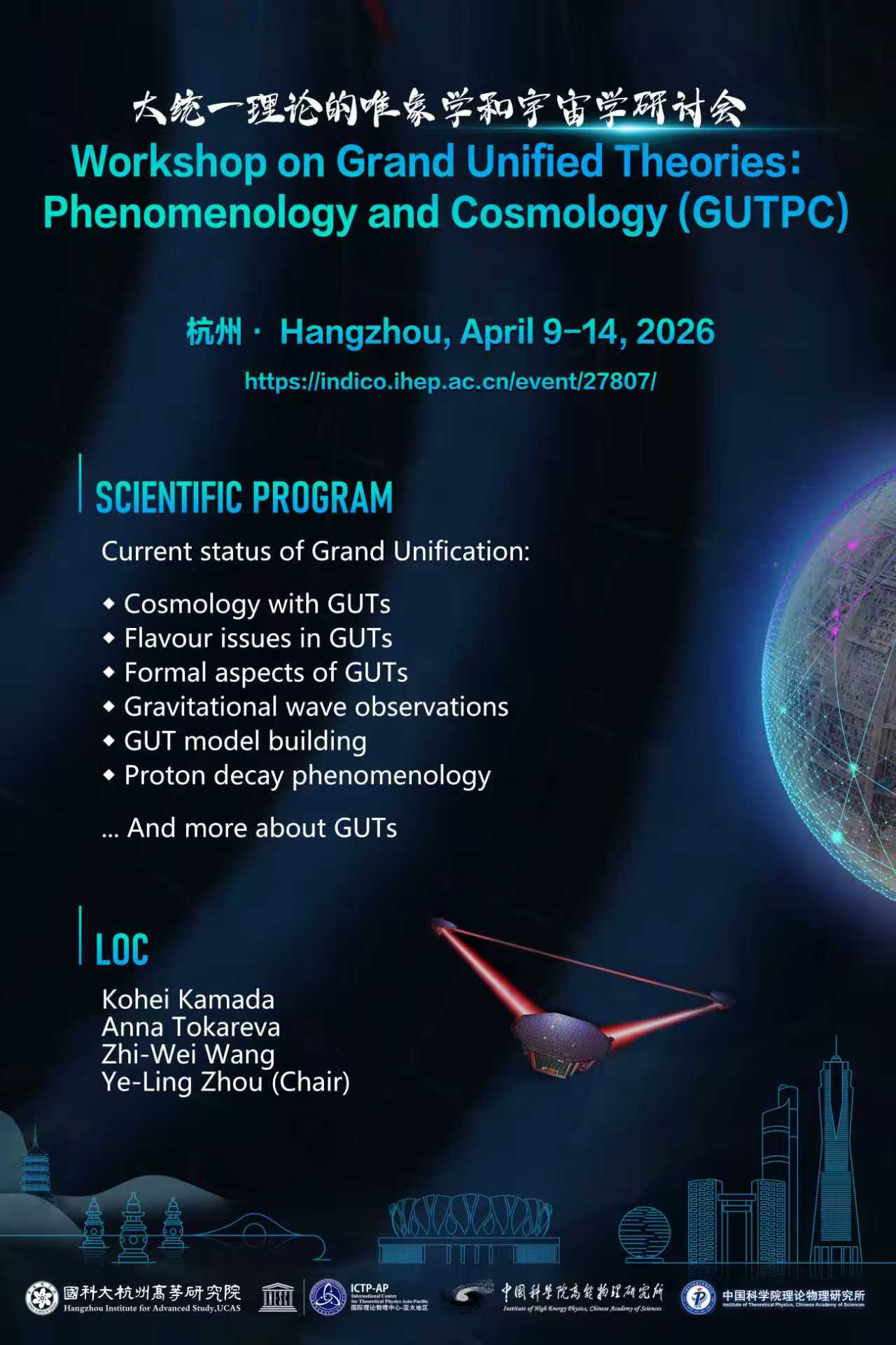
The 3rd Workshop on Grand Unified Theories: Phenomenology and Cosmology (GUTPC 2026)

Asia/Shanghai
Description

The Workshop on Grand Unified Theory, Phenomenology and Cosmology (GUTPC) will be hosted in Hangzhou Institute for Advanced Study (HIAS), University of Chinese Academy of Sciences (UCAS), on April 9-14, 2026, including registration day and leaving day. 

The aim of the workshop is to discuss recent progresses in Grand Unified Theories (GUT), which unifies all fundamental particle forces. Inspired by undergoing and upcoming gravitational wave observatories and precision measurements in neutrino experiments, we will focus on particle phenomenology and cosmology related to GUT.

Registration fee: 1500 CNY for staffs, 1000 CNY for students

Registration and abstract submission deadline: April 1st, 2026

Time: April 9-14, 2026 (arrival on 9, departure on 14)

Address: Conference Hall on Floor 2A, B3, Yunyi Campus of HIAS, UCAS

国科大杭州高等研究院云艺园区 3号楼 2楼报告厅

Contact: 
Ms. Jing Wang (SLXY@ucas.ac.cn)
Ms. Shutong Liu (liushutong@ucas.ac.cn)
Registration
Personal Data
Participants
  • Aldo Deandrea
  • Alexey Koshelev
  • Andrew Cheek
  • Anna Tokareva
  • Borut Bajc
  • Bowen Fu
  • Chang Hu
  • Chao-Qiang Geng
  • Chen Sun
  • Chun (纯) Liu (刘)
  • Danny Marfatia
  • Deshan Yang
  • Eung Jin Chun
  • Fei Wang
  • Fotis Koutroulis
  • Francesco Sannino
  • Frank Deppisch
  • Haijun Wang
  • Hajime Otsuka
  • Jessica Turner
  • Jia-Jun Wu
  • Jingya ZHU
  • Kohei Kamada
  • Lingfeng Li
  • Liu yutong
  • Long-Bin Chen
  • Mohammed Omer Khojali
  • Natsumi Nagata
  • Oleg Lebedev
  • Pavel Petrov
  • Peter Athron
  • Qing Chen
  • Roman Pasechnik
  • Runqi Kang
  • Saurabh Kumar Shukla
  • Sebastian Garcia-Saenz
  • Shao-Jiang Wang
  • Shihwen Hor
  • Shun Zhou
  • Shuntaro Aoki
  • Sin Kyu Kang
  • Takumi Kuwahara
  • Tao Zhu
  • Tianjun Li
  • Wei Chao
  • Wei(刘威) Liu
  • Wen-Hao Jiang
  • Wenyuan Ai
  • Xiao-Dong Ma
  • Xiao-Gang He
  • Xingyu Wang
  • Xiyuan Gao
  • Xubin Hu
  • Ye-Ling Zhou
  • Yi Yang
  • Yi-Lei Tang
  • Yifan Hu
  • YIFU CAI
  • Yoshiki Uchida
  • Yucheng Wang
  • Yufeng Li
  • Yuichiro Nakai
  • Zhen-hua Zhao
  • Zhi-zhong Xing
  • ZHIWEI 志伟 WANG 王
  • Zhiyong WANG
  • Zi-Qiang Chen
  • 君豪 刘
  • 海静 周
  • 贇 蒋
  • 赛雅 张
    • Registration
    • Plenary
      Convener: Zhi-zhong XING (IHEP, Beijing)
      • 1
        GUT Seesaw Parameters from low energy physics inputs

        TBA

        Speaker: Prof. Xiao-Gang He (TDLI)
      • 2
        Probing High-scale Physics with Neutrinoless Double Beta Decay

        TBA

        Speaker: Prof. Frank Deppisch (UCL)
    • break
    • Plenary
      • 3
        Modulus Stabilization of modular flavor models in Jordan frame supergravity

        We propose to discuss the modular flavor model and the stabilization of single modulus field in the Jordan frame supergravity with non-minimal scalar-curvature coupling. Modular invariance and positivity of the scale factor constrain stringently the form of the frame function, consequently the Kahler potential. We discuss some general properties of scalar potentials after the scale transformation from the Jordan frame to the Einstein frame. We find that the shape of the resulting scalar potential in the Einstein frame is quite different from that of ordinary single modulus stabilization mechanism. The scalar potential could be stationary at the fixed point, leading to a runaway type vacuum. We also discuss numerically the modulus stabilization for some simplified scenarios.

        Speaker: Fei Wang (Department of Physics, ZhengZhou University)
      • 4
        Inflation and Cosmological Collider Signals in Modular Theories

        Modular symmetry arises in various extensions of the Standard Model and plays an important role in particle phenomenology. In this talk, I explore its cosmological implications from the perspectives of inflation and cosmological collider physics. Modular inflation models lead to multi-field dynamics and characteristic primordial signatures, while modular extensions generically predict heavy states that can be probed through cosmological collider signals in non-Gaussianities. This provides a novel way to test modular symmetry in the early Universe.

        Speaker: Dr Shuntaro Aoki
      • 5
        Lepton Flavor Structure near a Modular Fixed Point

        Modular symmetry is a promising framework for flavor physics, where Yukawa couplings are described by modular forms. After a brief introduction to the basic idea, this presentation focuses on the behavior of modular forms near a fixed point and discusses how their general properties can shed light on lepton flavor structure

        Speaker: Xing-Yu Wang (Sichuan University)
    • Lunch
    • Plenary
      Convener: Shun Zhou (高能所)
      • 6
        Prominence: a discriminator of gravitational wave signals

        The concept of prominence is familiar to signal engineers, topographers and mountaineers. I will introduce prominence as a discriminator of gravitational wave signals.

        Speaker: Prof. Danny Marfatia (Hawaii University)
      • 7
        One Scale to Rule Them All: Metastable Strings and the PTA Signal

        We investigate the stochastic gravitational-wave background produced by metastable cosmic strings in a minimal $SU(2) \times U(1)$ dark sector. We demonstrate that a single-scale framework featuring a single Higgs field is sufficient to explain the signal reported by Pulsar Timing Arrays. By calculating the string decay rate via monopole nucleation within the thin-defect approximation, we identify a predictive parameter space where this model fits current observations. This framework provides a theoretically economical alternative to the multi-stage symmetry-breaking patterns typically invoked in the literature.

        Speaker: Prof. Jessica Turner (IPPP Durhan)
      • 8
        Non-Abelian Domain walls: oreo and CP violation

        The spontaneous breaking of an $A_4$ flavour symmetry can lead to the formation of domain walls. We study this phenomenon in the scenarios of real and complex $A_4$ symmetric scalar theories and discover new kinds of domain walls, which we denote as ``oreo''-type composite domain walls and CP-violating domain walls.

        Speaker: Bowen Fu (Northeastern University, Shenyang)
    • break
    • Plenary
      Convener: Kohei Kamada (HIAS, UCAS)
      • 9
        Proton Decay Patterns as Probes of Grand Unified Theories.

        TBA

        Speaker: Prof. Natsumi Nagata (Tokyo University)
      • 10
        BNV nucleon decays in the landscape of effective field theory

        In the talk, I will summarize our recent works on the study of baryon-number-violating nucleon decay modes, either with or without a new light particle in the final state. In light of the current and upcoming neutrino expriments, a solid theoretical description of all possible kinematically allowed decay modes is urgent. We work within the low energy effective field theory (LEFT) plus chiral perturbation theory (ChPT) framework, and construct the relevant LEFT operators and their corresponding hadronic chiral counterparts. Within the chial framework, we formulate the general expressions of the nucleon decay widths and analyze their characteristic experimnetal signatures, which facilitate experimental searches for those nucleon decays.

        Speaker: Dr Xiao-Dong Ma (SCNU)
      • 11
        Planck-Scale Effects on Nucleon Decay in Minimal Supersymmetric SU(5)

        We examine the impact on the phenomenology of the minimal supersymmetric SU(5) Grand Unified Theory (GUT) of dimension-5 operators with coefficients suppressed by the Planck mass scale, with particular emphasis on predictions for nucleon decay. We incorporate dimension-5 operators in both the Higgs sector and the Yukawa interactions in the theory, and take account of the constraints from gauge coupling measurements, the mass of the Higgs boson, fermion masses and the cold dark matter density. We consider two scenarios for soft supersymmetry breaking: the constrained minimal supersymmetric extension of the Standard Model (CMSSM) and the Non-Universal Higgs Model (NUHM). We present predictions for the nucleon decay modes p → π0e+, π0μ+, K+ ¯ν, π+ ¯ν, K0e+, K0μ+ and n → π0 ¯ν, π−e+, K0 ¯ν, which we compare with both the present experimental sensitivities and those projected for the JUNO and Hyper-Kamiokande experiments. We find that these experiments may have interesting possibilities for discovering several of these decay modes.

        Speaker: Shihwen Hor
    • Reception
    • Plenary
      Convener: Prof. Chao-Qiang Geng (HIAS)
      • 12
        Tracking down the route of GUT breaking

        TBA

        Speaker: Prof. Eung Jin Chun (KIAS)
      • 13
        TBA

        TBA

        Speaker: Prof. Francesco Sannino (Southern Denmark University)
    • break
    • Plenary
      Convener: Yu-Feng Li (IHEP)
      • 14
        SU(5) GUTs with or without SUSY?

        In this talk, I will discuss how essential supersymmetry remains for a realistic SU(5) GUT in light of current data. I first present our work “Revisiting CMSSM with non‑universal gaugino masses under current constraints”, where a generalized Planck‑scale mediated SUSY breaking allows non‑universal gaugino masses at the GUT scale and can accommodate the muon g-2 anomaly while satisfying Higgs data, LHC searches, and dark‑matter constraints. I then contrast this SUSY framework with a non‑SUSY SU(5) model with adjoint fermions, which explains neutrino masses, improves gauge coupling unification, and predicts potentially accessible triplet fermions. I compare their motivations, signatures, and prospects to assess the case for SUSY in SU(5) GUTs.

        Speaker: Prof. Jingya ZHU (河南大学)
      • 15
        $SU(5)$ Yukawa sectors beyond leading order

        $SU(5)$ grand unified model, which unifies SM quarks and leptons in $\overline{5}$ and $10$ dimensional irreducible representations, yields observationally inconsistent tree-level Yukawa relations when only a single $5_{\rm H}$ or $45_{\rm H}$ dimensional irrep having a single Higgs contributes to the Yukawa sector. For instance, only $5_{\rm H}$ dimensional Higgs in the Yukawa sector yields $Y_d = Y_e^T$, while $45_{\rm H}$ gives $3Y_d = Y_e^T$. These inconsistent tree-level Yukawa relations can be rendered viable by switching on one-loop corrections to different Yukawa vertices. The former scenario requires extending the minimal model by $SU(5)$ singlets while the latter one requires splitting of mass of scalars residing in the same multiplet. Other setups are also explored where radiative effects make the inconsistent tree-level frameworks viable. As an application, a realistic, viable $SU(5)\times Z_3$ framework is constructed explaining neutrino-less double beta decay and adhering to proton decay constraints. Importantly, the findings highlight the feasibility of the simplest Yukawa sector when accounting for quantum corrections and substantial threshold effects.

        The talk is based on the following references:
        -- Phys.Rev.D 109 (2024)
        -- 2411.06906 [hep-ph]
        -- JHEP 01 (2026) 061

        Speaker: Dr SAURABH KUMAR SHUKLA (Nankai University)
      • 16
        Extended SO(10)-inspired models and leptogenesis

        We investigate type-I seesaw frameworks motivated by Grand Unification, focusing on the generic consequences of hierarchical Dirac neutrino masses as expected in many SO(10)-type constructions where neutrino Yukawa couplings are linked to the up-quark sector. Excluding the well-known highly fine-tuned crossing-level solutions and using current low-energy neutrino data, we show that these setups generically lead to a strongly hierarchical right-handed (RH) neutrino spectrum, with RH masses scaling approximately as M_i \propto m_{D i}^2; remarkably, this conclusion holds independently of any additional model-dependent assumptions on the Dirac neutrino mass matrix. If, moreover, the Dirac neutrino masses are not too different from the up-quark masses, as naturally suggested by GUT relations, the intermediate RH neutrino N_2 lies in the mass range required for successful N_2-leptogenesis, extending and strengthening the applicability of SO(10)-inspired leptogenesis beyond specific texture choices. We also include flavour coupling effects in the computation of the final asymmetry within this extended GUT-motivated leptogenesis class and discuss their quantitative impact on the viable parameter space.

        Speaker: Xubin Hu (University of Southampton)
      • 17
        TeV-scale scalar leptoquarks motivated by B anomalies improve Yukawa unification in SO(10) GUT

        It is common practice to explain deviations between data and Standard-Model (SM) predictions by postulating new particles at the TeV scale ad-hoc. This approach becomes much more convincing, if one successfully embeds the postulated particles into a UV completion which addresses other conceptual or phenomenological shortcomings of the SM. We present a study of an SO(10) grand unified theory which contains scalar leptoquark fields employed to explain the ``flavour anomalies'' in $b\to s$ and $b\to c$ decays. We find that the additional degrees of freedom improve the renormalization-group (RG) evolution of the SM parameters. In particular, the light leptoquarks modify the RG evolution of the Yukawa couplings such that successful bottom-tau unification becomes possible in a minimal SO(10) GUT with only a $126$-plet coupling to fermions.

        Speaker: Xiyuan Gao (KIT, Karlsruhe, TTP)
    • Lunch
    • Plenary
      • 18
        Hints of an Electroweak Phase Transition and Electroweak Baryogenesis?

        We know from the discovery of the Higgs boson that electroweak symmetry is broken through the Higgs mechanism, but we expect this should be restored at high temperatures in the early universe. Thus we believe the matter in the universe underwent a dramatic change of state as the universe cooled down. Electroweak phase transitions have many important consequences, for example if strongly first order they may provide an explanation of the baryon asymmetry of the Universe and could produce observable gravitational waves. I will discuss some possible experimental hints for such a phase transition, taking a critical look at connections to pulsar timing arrays and exploring the possibility that anomalies in flavour physics may hint at both an electroweak phase transition and successful electroweak baryogensis.

        Speaker: Peter Athron (Nanjing Normal University)
      • 19
        A GUT-scale first-order phase transition during Starobinsky inflation

        Ending the inflation by vacuum decay is considered infeasible due to the graceful exit problem. Even if considering an alternative field other than the inflaton to realize a first-order phase transition (FoPT) during inflation, it is usually challenging for concrete model building, as bubble nucleations might not be fast and dense enough to successfully end the inflation. In this work, we propose a FoPT at the grand-unification-theory (GUT) scale within the Starobinsky inflation. The key construction is an exponentially evolving potential barrier dynamically controlled by the rolling inflaton, so that almost no bubble is nucleated during the early inflationary era, but with massive bubble nucleations near the end of inflation. With lattice numerical simulations, we have successfully tested this GUT-FoPT during Starobinsky inflation, and the resulting gravitational-wave energy density spectrum reproduces previous analytical estimation with a distinctive oscillation feature at high frequencies.

        Speaker: Shao-Jiang Wang (I)
      • 20
        High-frequency gravitational waves from first-order phase transitions

        First-order phase transitions in the early Universe are a well-motivated source of gravitational waves. In this talk, I will discuss a previously overlooked gravitational wave production mechanism: gravitational transition radiation, arising from graviton emission by particles whose mass changes as they pass through expanding bubble walls. The resulting spectrum features a distinctive shape with a peak frequency redshifting to 10 GHz, corresponding to the current temperature of the Universe. This mechanism is generic and is expected to operate similarly for domain walls and other relativistic interfaces.

        Speaker: Wenyuan Ai (Tsung-Dao Lee Institute, Shanghai Jiao Tong University)
    • break
    • Plenary
      Convener: Prof. Tao Zhu (Zhejiang University of Technology)
      • 21
        Inflation vs Bounce: red or blue, and how much blue?

        In my talk I will focus on renormalizable and ghost-free quantum gravity proposals. An important feature of these models is the presence of infinite derivative operators. Such models on contrary to local gravity modifications can give a blue tilted spectrum of primordial GWs while local models uniquely predict a red tilted primordial GWs spectrum. This is an essential possible observational signature of non-local gravity models. On top of this non-local gravity models can realize stable non-singular cosmological bounce which with necessity results in a blue tilted GW spectrum. Implications for observations and ways to distinguish bounce and inflation will be discussed.

        Speaker: Prof. Alexey Koshelev (ShanghaiTech)
      • 22
        Cosmology in warped massive gravity

        I will discuss the cosmology of a brane-world realization of massive gravity. The theory, known as warped massive gravity, postulates the existence of dRGT potentials in the 5D bulk and in the 4D brane, and has the virtue of raising the strong-coupling scale of the 4D theory. Although generically the 4D dynamics cannot be decoupled from the bulk equations, we identify, in the cosmological context, two classes of models that lead to decoupled equations for the scale factor on the brane. The first model is peculiar because it is not described by a Friedmann-type equation, and accommodates interesting solutions including bounces without exotic matter. The second class leads to a generalization of the DGP model equation, and a preliminary analysis shows the potential of the theory to alleviate the Hubble tension.

        Speaker: Prof. Sebastian Garcia-Saenz (SUSTech)
      • 23
        Nonsingular Cosmologies in Horndeski Gravity

        We investigate a range of non-singular cosmological scenarios within the framework of Horndeski gravity. In particular, we construct a bouncing Universe model and propose a minimal setup that realizes a non-pathological Genesis scenario. Both constructions allow for a fully stable transition to the kination epoch, during which General Relativity (GR) is restored. These scenarios successfully evade the no-go theorem, almost at the expense of potential strong-coupling issues in the early phase. The requirement of strong-coupling avoidance imposes strict constraints on the model parameters and, in certain cases, forbids the generation of a red-tilted scalar spectrum. Furthermore, we explore an alternative scenario in which the Genesis phase precedes a period of Starobinsky inflation. We show that the corrections from the Genesis phase can naturally account for the recent ACT observations.

        Speaker: Dr Pavel Petrov (IBS Daegeon)
    • Banquet
    • Plenary
      • 24
        Paths to Solving the Strong CP Problem and the Footprints Left Behind

        We explore two major approaches to the strong CP problem, the axion solution and spontaneous CP violation (SCPV). We first focus on composite axion models, which provide a compelling realization of the axion solution but face serious cosmological challenges, in particular the domain wall problem. We present a new framework based on a special embedding of gauge symmetries, where the domain wall number is reduced to unity in the ultraviolet theory, and small instanton effects induce a controlled bias term that lifts the vacuum degeneracy and allows domain walls to decay without spoiling the axion solution. We then turn to the axionless approach based on SCPV, where CP is an exact symmetry of the Lagrangian and is broken only spontaneously. In supersymmetric theories, SCPV can be realized along flat directions and stabilized by supersymmetry-breaking and non-perturbative dynamics, and the framework is compatible with viable cosmology including Affleck–Dine baryogenesis. These mechanisms provide distinct paths to resolving the strong CP problem with testable implications.

        Speaker: Yuichiro Nakai (Shanghai Jiao Tong University)
      • 25
        New Axion Misalignment Mechanism

        As compelling cold dark matter candidates, the mechanism underlying axion generation in the early Universe remains a central focus of contemporary research. Conventional misalignment mechanisms, however, have not systematically incorporated key physical effects including the initial velocity and initial field value of the axion. In this Letter, we comprehensively investigate the impact of pri- mordial magnetic fields (PMFs) on axion production abundance. Specifically, considering the axion coupling to the Chern-Simons term of the U(1) hypercharge gauge field, its equation of motion is modified into that of a driven oscillator. This modification effectively shifts the onset time of axion oscillations, which in turn significantly alters the relic abundance of axions in the early Universe. We term this novel axion production effect the axion helical misalignment mechanism. Furthermore, if chiral asymmetries exist in the early Universe, the chiral magnetic effect (CME) will also contribute to axion evolution. The coexistence of the axion field and the CME exerts a profound influence on the evolution of Standard Model (SM) chiral fermions, and this modification to fermion evolution ultimately leads to the generation of the baryon asymmetry of the Universe.

        Speaker: Wei Chao (BNu)
    • break
    • Plenary
      Convener: Zhi-Wei Wang (University of Electronic Science and Technology of China (UESTC))
      • 26
        Is there a UV free E6 GUT?

        Realistic E6 GUTs were proposed in recent years with nice and peculiar features like the existence of a dark matter candidate and/or a correct Yukawa structure. The price to pay in such models is the use of large representations of the E6 group, which make the theory UV non-free with a Landau pole less than one order of magnitude above the GUT scale. I will present in this talk an E6 model with only 27 and 78 dimensional representations which are potentially realistic and which may be well behaved up to the Planck scale. The work is in progress in collaboration with K. Babu and Vasja Susič.

        Speaker: Prof. Borut Bajc (Jožef Stefan Inst)
      • 27
        Asymptotic Grand Unified models

        We present the idea of asymptotic grand unification, where the gauge couplings run to a unique fixed point in the ultraviolet, thanks to the presence of a compact extra dimension and to a specific choice group structure and multiplet content. We introduce a minimal model based on a SU(5) gauge theory but also discuss SO(10) and other generalisations, giving also few results on the expected phenomenology.

        Speaker: Prof. Aldo Deandrea (University Lyon 1)
      • 28
        UV behavior and symmetry breaking of 5D asymptotic GUTs

        Asymptotic grand unification (aGUT) replaces conventional fixed-scale unification by ultraviolet-safe flows toward a common interacting fixed point. Five-dimensional orbifold gauge theories are a natural arena for aGUT model building, but viability requires both a stable orbifold vacuum and consistent UV fixed points. I present general stability criteria for gauge breaking on $S^1/(\mathbb{Z}_2\times\mathbb{Z}_2^\prime)$ and a systematic classification of symmetry-breakingpatterns in bulk $SU(N)$, $SO(N)$, and $Sp(N)$ theories. Applying these criteria singles out viable routes, including a unique $SU(6)$ pathway to the Standard Model and an $SU(8)$ realization with an intermediate Pati-Salam stage. I then discuss the exceptional-group case: under minimal assumptions, stable orbifold vacua do not yield a minimal exceptional (non-SUSY) aGUT, motivating non-minimal ingredients. Finally, I summarize one-loop renormalization results for 5D gauge-Yukawa theories, deriving conditions for simultaneous UV fixed points in gauge, Yukawa, and scalar couplings. These conditions provide a useful discriminator between genuinely UV-consistent 5D models and effective descriptions.

        Speaker: Prof. Roman Pasechnik (Lund University)
    • Lunch
    • Plenary
      Convener: Yi Yang (Shanghai Tech)
      • 29
        The Three-Family N=1 Supersymmetric Pati-Salam Models from Type IIA String Theory on T^6/(Z_2 ×Z_2) Orientifold with Non-Rigid and Rigid Intersecting D6-Branes

        We provide a systematic construction of three-family N=1 supersymmetric Pati-Salam models from Type IIA orientifolds on T^6/(Z_2 × Z_2) with intersecting D6-branes. All the gauge symmetries SU(4)C × SU(2)_L × SU(2)_R arise from the stacks of D6-branes with U(n) gauge symmetries, while the hidden sector is specified by USp(n) D6-branes. The Pati-Salam gauge symmetry can be broken down to the SU(3)_C × SU(2)_L × U(1){B-L} × U(1){I{3R}} via D6-brane splittings, and further down to the Standard Model (SM) via the D- and F-flatness preserving Higgs mechanism from massless open string states in a N=2 subsector. We show that there are only 33 independent models with different gauge coupling relations at string scale after modding out equivalent relations. We study the gauge coupling unification, SM fermion masses and mixing, as well as supersymmetry breaking soft terms. In addition, to forbid the open string moduli, we consider rigid D6-branes. We construct, for the first time, the three-family supersymmetric Pati-Salam models from rigid intersecting D6-branes on a factorizable orientifold with discrete torsion, and discuss their phenomenological implications as well.

        Speaker: Prof. Tianjun Li (Henan Normal University)
      • 30
        Flavor Physics and CP from Non-Invertible Selection Rules

        In this talk, I will discuss the application of non-invertible selection rules to flavor physics and CP, in which matter fields are labeled by conjugacy classes of a finite group rather than its irreducible representations. We show that this framework leads to novel texture structures in the Yukawa couplings of quarks and leptons that cannot be realized by conventional group-theoretic (invertible) symmetries. Furthermore, when the fusion rules admit a Z2 symmetry identified with charge conjugation, a CP-invariant system can be consistently defined together with parity transformation. As a result, combining group-based flavor symmetries underlying non-invertible selection rules with CP symmetry naturally gives rise to a generalized CP transformation. We also demonstrate the possibility of spontaneous CP violation in this framework and discuss its implications for Yukawa textures. Finally, I will introduce top-down realizations of non-invertible selection rules arising from string compactifications, such as type IIB superstring theory on toroidal orbifolds and heterotic string theory on non-Abelian orbifolds.

        Speaker: Hajime Otsuka
      • 31
        Model Building with Non-Invertible Selection Rules: Two Examples in Lepton Physics

        Non-invertible symmetries have recently provided new possibilities for particle-physics model building. In this talk, I will discuss two examples based on non-invertible selection rules in lepton physics. The first is a radiative lepton model based on the Ising fusion rule, where the charged-lepton mass hierarchy is partially generated through one-loop dynamical symmetry breaking, while neutrino masses, a viable dark matter candidate, and the muon g−2 can be addressed within the same framework. The second is a loop-induced neutrino-mass model based on the Fibonacci fusion rule, where a small induced vacuum expectation value arises radiatively in the presence of higher electroweak multiplets, and the effective cut-off scale is tied to the renormalization-group behavior of the SU(2)_L gauge coupling. These examples are intended to show how non-invertible symmetry may provide a useful organizing principle for constructing viable models of lepton masses and related new-physics phenomena.

        Speaker: Dr Jia-Jun Wu (Henan Normal University)
    • break
    • Plenary
      Convener: Ye-Ling Zhou (Hangzhou Institute for Advanced Study)
      • 32
        Unifying Neutrino Mass and Cosmology in a Triplet-Doublet Extension

        We propose an extension of the standard model (SM) by two SU (2) triplet scalars and an inert SU (2) doublet. We demonstrate that this setup can simultaneously produce an inflaton and baryon asymmetry in the early universe, provide a dark matter candidate and explain the smallness of neutrino masses. The required CP -violation for lepton asymmetry is obtained by interference between the triplet mediators that communicate the dark sector to the SM sector. More precisely, the complex Breit-Wigner propagators of the triplets and their mixing, result in an asymmetric production of leptons and antileptons that is boosted before dark matter freeze-out. In this case, simultaneously achieving enough dark matter relic abundance and proper matter-antimatter asymmetry limits the available parameter space of the model. Moreover, the scalar triplets are coupled non-minimally to gravity and give rise to the inflaton.

        Speaker: Prof. Sin Kyu Kang (Seoul Tech)
      • 33
        Revealing Neutrino Mass Orderings at Colliders

        TBD

        Speaker: Wei(刘威) Liu (Nanjing University of Science and Technology(南京理工))
      • 34
        Prospects for probing DM with the TRIDENT neutrino telescope

        I will discuss the potential neutrino telescopes will have for probing dark matter particle models. I will present recent work with the TRIDENT collaboration where we project the experiments future sensitivity to annihilating DM. We project that TRIDENT is on track to reach annihilation rates below the thermal freeze-out benchmark for dark matter masses between 1-100 TeV. However, I will highlight that a previously overlooked background of Galactic neutrinos could limit our sensitivity and potentially mimic the dark matter signal. These neutrinos are produced from interactions between hadronic cosmic rays and interstellar gas. I will comment on a particle physics model that would be uniquely probed by TRIDENT and current work related to dark matter decay and solar capture.

        Speaker: Andrew Cheek (TDLI, SJTU)
    • Plenary
      • 35
        Matter-genesis via Heavy particle decay from Primordial Black Holes

        We investigate the possibility of baryogenesis scenarios where the evaporation of the primordial black holes (PBHs) formed in the early universe can be sources of the matter-genesis in the universe. The PBHs evaporate before the Big-bang nucleosynthesis as their mass is below 10^9 g, and no PBH remains in the current universe. Even if the plasma temperature is well below the particle mass, such particles can be produced from the last stage of the evaporation. The matter-genesis through the heavy particle decay requires the presence of such heavy particles in the universe. In this work, we have demonstrated the possible GUT-like baryogenesis and cogenesis scenario for baryon and dark-matter asymmetries in the composite DM realization.

        Speaker: Takumi Kuwahara (Jilin University)
      • 36
        Isocurvature Features from Affleck-Dine Type Baryogenesis

        The Affleck–Dine mechanism is a leading baryogenesis scenario in which scalar condensates form coherently during inflation along supersymmetric flat directions that are lifted by supersymmetry-breaking effects. We update the viable parameter space for baryogenesis using recent Cosmic Microwave Background constraints on baryon-density isocurvature perturbations, taking the quantum fluctuations of the scalar condensate generated during inflation as initial conditions.
        We then show that primordial features arising from the inflaton sector can serve as a unique probe of baryogenesis models, whose mechanisms are otherwise difficult to access directly due to their high energy scales. These primordial features leave correlated imprints, such as sharp feature signals and clock signals, on both the curvature and baryon-density isocurvature perturbations, providing direct evidence for the existence of both light and heavy modes involved in the Affleck–Dine mechanism.

        Speaker: Lingfeng Li (Brown University)
    • break
    • Plenary
      Convener: Anna Tokareva (HIAS)
      • 37
        Gravitational particle production

        I discuss production of very weakly interacting or free particles in the Early Universe. Due to inflation and postinflationary dynamics such particles are produced copiously even in the absence of any non-gravitational couplings. This phenomenon has important implications for dark matter physics.

        Speaker: Prof. Oleg Lebedev (Helsinki U)
      • 38
        Cosmological Gravitational Particle Production: Sterile Neutrinos as Dark Matter candidates

        In this work we consider cosmological gravitational production of Dirac sterile neutrinos as dark matter candidates during and after inflation. In the former, the Higgs field experiences large quantum fluctuations driving its average field value to the Hubble scale and above facilitating the sterile neutrino production. However, the production efficiency due to classical gravity still remains suppressed compared to the standard freeze-in mechanism. Quantum gravitational effects, on the other hand, are expected to break conformal invariance of the fermion sector by the Planck scale-suppressed operators irrespective of the mass. We find that such operators are very efficient in fermion production immediately after inflation, generating a significant background of stable or long-lived feebly interacting particles. This applies, in particular, to sterile neutrinos which can constitute cold non-thermal dark matter for a wide range of masses, including the keV scale.

        Speaker: FOTIS KOUTROULIS (IHEP)
      • 39
        Freeze-in sterile neutrino DM in a feebly gauged $B-L$ model

        We consider the gauged $\mathrm{U(1)_{B−L}}$ model and examine the situation where the sterile neutrino is a dark matter candidate produced by the freeze-in mechanism. In our model, the dark matter $N$ is mainly produced by the decay of a $\mathrm{U(1)_{B-L}}$ breaking scalar boson $\phi$. We point out that the on-shell production of $\phi$ through annihilation of the $\mathrm{U(1)_{B-L}}$ gauge boson $Z'$ plays an important role. We find that the single production of $Z'$ from the gluon bath in the early Universe can become the main production mode for $Z'$ in some parameter regions. To prevent $N$ from being overproduced, we show that the $\mathrm{U(1)_{B-L}}$ gauge coupling constant $g_{B−L}^{}$ must be as small as $10^{−16}-10^{-10}$. We also consider the case where the decay of $\phi$ into $N$ is kinematically forbidden. In this case, $N$ is generated by the scattering of $Z '$ and the $g_{B-L}^{}$ takes values of $10^{−10}-10^{-6}$, which can be explored in FASER, FASER2 and SHiP. We will show the sensitivity of FASER, FASER2, and SHiP. This talk is based on JHEP 05 (2025) 147 and ongoing research.

        Speaker: Yoshiki Uchida (South China Normal University)
      • 40
        Probing quark-lepton correlation in GUTs with high-precision neutrino measurements

        GUTs unify quarks and leptons into same representations and predict correlations between their masses and mixing. We perform numerical scans in SO(10) GUTs to explore the flavor space with new data of JUNO taken into account. The quark-lepton correlation shows the preference of normal ordering for light neutrino masses, predicts favored region of the CP-violating phase in neutrino oscillations, and classifies GUT models based on their testability in neutrinoless double beta decay experiments. The quark-lepton correlation predicts mass spectrum of right-handed neutrinos, pointing to the energy scale of baryon and lepton number violation and providing sources for baryogenesis. We emphasize that, as high precision measurements of neutrino physics are coming, the quark-lepton correlation will provide increasingly important role in the testability of GUTs, complementary to proton decay measurements.

        Speaker: Zi-Qiang Chen (HIAS-UCAS)
    • Lunch
    • Excursion